Economy
Putting a brake on inflation
By Wang Xiaotian (China Daily)
Updated: 2010-11-22 09:39
 |
Large Medium Small |
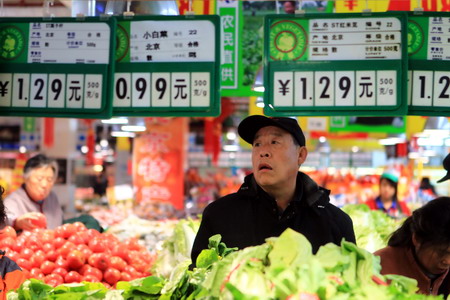
A customer calculates vegetable prices at a supermarket in Beijing.[Photo / China Daily]
Higher yuan could help curb rapidly rising consumer prices
BEIJING - The fluctuation range of China's currency exchange rate can be further broadened to help curb rising inflation, Li Daokui, a member of the monetary policy committee of the People's Bank of China, said at a forum on Saturday.
"The rapid price rises that the country faces are largely propelled by increasing costs instead of surging demand, leaving room for the Chinese yuan to appropriately appreciate to counter the rising prices of international commodities," Li said at the China Macroeconomic Forum held at Beijing-based Renmin University of China.
Earlier in October, he said China can afford an annual 3 to 5 percent appreciation of the yuan. "Of course, the pace of the yuan's appreciation should be based on domestic factors," he said, adding the country's reliance on external demand has declined somewhat this year.
He predicted China's trade surplus would drop from $190 billion in 2009 to $180 billion this year, accounting for 3.5 percent of the country's estimated gross domestic product (GDP) in 2010, a noticeable reduction from the pre-crisis level of 7.9 percent.
Commenting on another change in the country's economic growth pattern, he said domestic consumption has started to play a leading role among the driving factors that determine China's GDP, further reducing the country's dependence on exports.
Consumption is expected to account for 55.4 percent of China's GDP in 2010, overtaking investment for the first time as the biggest driver of economic growth, according to a report released on Saturday by Renmin University of China.
"That shows the government's efforts to shift the momentum of its economic growth from external to domestic demand, especially consumption," said Liu Yuanchun, deputy head of the university's School of Economics.
A nominal year-on-year increase of consumer goods sales will reach 18.3 percent this year and maintain a growth rate of 17.8 percent in 2011. "China has stepped into a consumption-driving time," the report said.


"The year 2011 will be the most complicated year for macroeconomic management," Liu said, urging the government to make curbing inflation its top priority next year.
He said the Consumer Price Index (CPI), a key gauge of inflation, is likely to show year-on-year growth of 3.2 percent this year, possibly slowing down to 3 percent in 2011, and that an annual 3 percent increase in the CPI could be expected in coming years.
China's CPI surged 4.4 percent in October from a year earlier, reaching a 25-month high, according to the National Bureau of Statistics. Some analysts have predicted the figure may rise to nearly 5 percent in November.
The central bank lifted reserve requirements for banks on Friday evening, the second time in nine days, to soak up superfluous liquidity and cage the inflation tiger.
The State Council, China's cabinet, over the weekend also ordered local governments to take steps to rein in surging food prices, which usually account for one-third of the country's CPI.
Among the central government's other recommendations, local authorities were encouraged to boost production to ensure supplies are adequate, while checking irrational demand and punishing illegal activities that push prices up. Reducing the cost of agricultural products and providing temporary subsidies were also urged as measures.
From Dec 1, highway toll stations are forbidden from collecting fees from vehicles being used to transport fresh agricultural products, according to a circular on the central government's website.
Local governments must also disburse subsidies temporarily and establish coordinated social-security mechanisms that are capable of providing gradual rises in basic pensions, unemployment insurance and minimum wages, the circular said.
Liu said rising vegetable prices could be absorbed by the market in two months, while grain price hikes could be balanced in eight months.