Top Biz News
Resource tax to be expanded nationwide
By Wang Xiaotian (China Daily)
Updated: 2011-01-26 09:42
 |
Large Medium Small |
|
 |
|
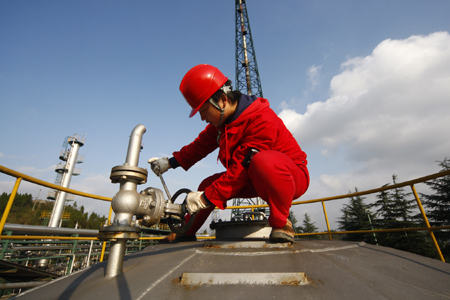
A worker at a natural gas plant in Suining, Sichuan province. The Ministry of Finance said the country will apply the resource tax, currently on oil and natural gas, to coal and water.?[Photo / China Daily] |
Finance minister says duties will be reformed to promote fiscal growth
BEIJING - China's Finance Minister Xie Xuren said the country will extend the resource tax - currently only in force in the Xinjiang Uygur autonomous region - to other areas in the coming five years while stepping up a revision of the country's fiscal and tax system.
"We must accept that China is a developing country with 1.3 billion people and uneven regional and urban-rural development. Therefore the fiscal gap (between revenue and expenditure) will still be prominent in the near future," said Xie in an interview with the Xinhua News Agency and People's Daily on Monday.
He said the country will push reform of the taxation system, especially those changes aimed at reducing the reliance of local governments on the real estate sector.
In July 2010, the National Development and Reform Commission (NDRC), the country's top economic planning agency, announced a plan to extend a pilot resource tax plan - originally introduced in June in the Xinjiang Uygur autonomous region on oil and natural gas - to all 12 of the western provinces and autonomous regions, and it said it will extend it across the entire nation.
The benchmark rate will be set at 5 percent and will vary across commodities, according to the NDRC. The levy will be based on the price instead of volume of commodities produced and will be widened to apply to coal and water.
Xie also vowed to reform individual income tax levied on high-income groups and to promote reform of real estate taxes during the next five years.
In this way the commission hopes to build a "scientific and reasonable" fiscal system to facilitate sustainable growth.
"The reform of the resource tax will definitely benefit the nation's plans for sustainable growth by discouraging the exploitation of resources. It will also help to solve the developmental imbalances in different regions by boosting local fiscal revenues," said Zhou Mingjian, an analyst with Pacific Securities.
China has been widening local tax channels, such as those on vehicles, property, and resources, to increase the fiscal revenue of local governments, which are not allowed to borrow directly from banks or issue bonds to fund deficits and support infrastructure construction.
The nation will also allocate fiscal revenue between central government and local authorities in a more balanced manner, in accordance with the respective administrative responsibilities, said Xie.
The power to decide on local tax categories, rates, and cuts will be given to the provincial-level governments during the next five years, he said in a commentary for Qiushi magazine published in November.
Analysts said that move could help local governments expand their revenue sources and reduce fiscal reliance on the real estate market and local debts, which have accumulated as the authorities expand infrastructure construction and other urbanization-related projects.
"We will empower the provincial authorities to manage tax policies properly, and nurture pillar-tax sources at a local level under the auspices of a unified tax administration," said Xie.
| ||||


Xie also said the ratio of fiscal revenue to GDP is at a very low level compared with other countries, and the government will continue to make efforts to maintain stable fiscal revenue growth, to avoid greater tension between fiscal revenue and expenditure.
In 2010, China's fiscal revenue totaled more than 8.3 trillion yuan ($1.3 trillion), a 21.3 percent increase from a year earlier. At the same time, the government spent more than 8.9 trillion yuan, a rise of 17.4 percent year-on-year.
China's fiscal revenue growth is likely to slow, partly because of planned taxation reforms, and the nation will face more pressure in 2011, said Xie at the national fiscal work conference in late December.
More funds will be spent on education, health and social security to improve public well-being, as well as agricultural and irrigation projects, the minister said.
| 分享按鈕 |