Opinion
Is the wealth gap widening?
By He Bolin (China Daily)
Updated: 2011-04-14 15:14
 |
Large Medium Small |
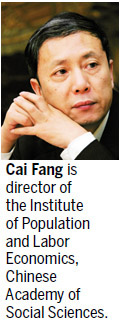
The wealth gap in China is wide. And the consensus is that it is widening further. But is it?
"Maybe not," says Cai Fang, director of the Institute of Population and Labor Economics, Chinese Academy of Social Sciences. He says the increase and expansion in subsistence allowance, better minimum wages and other poverty alleviation measures show that is not the case.
Cai's views have already sparked a heated debate on the Internet, with many netizens challenging his contention. They say there are more than enough indications in society today to show that the wealth gap is widening, and the government should take steps to narrow it.
Cai agrees with them on one point: The government has to take measures to narrow the wide wealth gap. It is true that China's Gini coefficient, an indicator of inequality, is approaching 0.5 (the globally accepted red line is 0.4, with 0 representing equal distribution of national wealth). But it is wrong to conclude that the wealth gap is widening further. Every country's statistics have their own characteristics, and China's is no exception. It is thus important to see them in the right perspective.
For instance, he says, migration of people within the country has narrowed the income gap between urban and rural areas. But the rising income of migrant workers is missing from the data, even though their income has seen a double-digit growth since 2004. Their income is missing from the data because it is not calculated as part of earnings of either rural households or urban families.
|
||||


China has a fast income growth, he says, and its per capita GDP is growing at 8 percent. In fact, urban and rural residents' income has grown more or less at the same rate over the last three decades.
China has experiencing labor shortage in the coastal areas, and central and western regions - on different scales - for some time now. This indicates it has reached the Lewis Turning Point - the point, according to Nobel Prize-winning economist Arthur Lewis, when a developing country's industrial wages begin to rise quickly with the trickling down of surplus labor supply from the countryside. The coastal areas, for instance, have been facing labor shortage since 2003, except for a short time in 2009 when the global financial crisis brought many a factory to a standstill.
Some experts argue that the Lewisian Turning Point can't be applied to China where farmers working in cities are still treated as rural residents. But Cai says that can be attributed to China's special urban-rural structure, and the Lewis Turning Point, as a general economic concept, is very much applicable to the country.
Given the trend of rising wages, he says, the current labor shortage in China is relative rather than absolute. And wages have risen because the demand for labor is growing faster than its supply.
Besides, the average age of migrant workers has been increasing, which means their number is also increasing. Many of the first-generation migrant workers returned to the countryside once they reached their 30s. But with far more jobs available now, a larger number of migrant workers are staying in cities much longer.
The government's drive to develop Central and West China has created many jobs, too, and higher wage offers will ensure that more surplus labor from the countryside is drawn to those regions.
Cai objects to everyone complaining about the wealth gap when the task now is to find ways to narrow it. "The gap won't narrow on its own." One way of reducing it is to reform the individual income tax system, he says.
Personal income tax may have made up only 6.6 percent of the government's total tax revenue last year, but it is a heavy burden for low- and medium-income groups. It's time the government increased the income tax threshold for the low- and medium-income groups. To offset the loss in revenue, it can levy higher taxes on the rich and superrich.
Cai also suggests setting up a collective wage consultation system in which labor authorities, trade unions and the business enterprises would represent their sectors. No, it would not be a platform for bargaining. Rather it would be a place to hold serious and scientific discussions on data and to analyze industries' prospects, which will help the representatives to suggest more ways to reduce the income gap.
On the social security front, China has established two systems: a basic old-age insurance system for urban residents and a new rural social endowment insurance system. There are plans to expand the rural social endowment system to cover 40 percent of the people in the countryside.
In some countries, social security is part of social welfare regardless of whether a person's social contribution entitles him/her for such treatment. China's rural social endowment insurance system follows the same principle. Given the prevailing conditions in the country, its standard may be relatively low. But a lower level will facilitate wider coverage.
And of course a certain percentage of State-owned enterprises' profit should be used to improve social security.
With so much happening and indications of more to happen how can we say that the wealth gap is widening further in the country? Cai says.

| 分享按鈕 |