Statistics
China loses $271b from debt holdings
By Wang Xiaotian (China Daily)
Updated: 2011-05-06 09:18
 |
Large Medium Small |
|
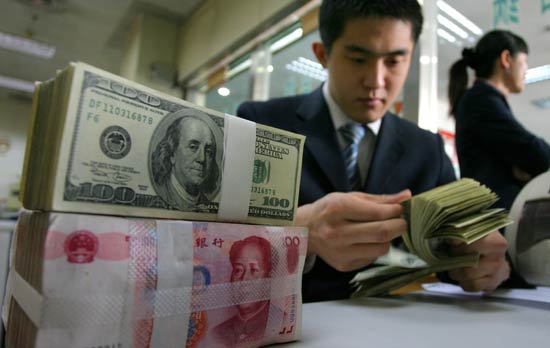 A bank employee counts US dollars in Nanjing. By the end of March, China's foreign reserves increased by $197 billion to more than $3 trillion for the first time, a rise of 24 percent from the previous year. [Photo/ China Daily] |
BEIJING - China suffered a loss of about $271.1 billion on its foreign exchange reserves accumulated between 2003 and 2010, because of the depreciation of the US dollar, said a senior analyst at the National Development and Reform Commission (NDRC).
And the country is likely to lose $578.6 billion if the US currency's exchange rate sinks to six yuan a dollar, Securities Daily quoted Zhang Anyuan, head of the fiscal and financial policy research division of the NDRC's Institute of Economic Research, as saying on Thursday.
"This amount of loss cannot be offset by the country's overseas investment earnings," Zhang said in a recent article, according to the report.
Zhang said that diversification of China's foreign exchange portfolio is already crucially urgent for the country to maintain the value of the assets.
In February, the State Administration of Foreign Exchange (SAFE) reiterated that security is its top priority when making investments using the foreign reserves, and it has already taken appropriate measures to offset potential major risks.


Zhou Xiaochuan, governor of the People's Bank of China (PBOC), said in April that the holding has exceeded a "reasonable" level and the management and diversification of the portfolio needs to be improved.
China, the biggest buyer of US debt, trimmed its holdings for a fourth straight month in February to $1.15 trillion, according to data released by the US Treasury Department, while its total foreign exchange holdings increased by 0.5 percent to reach $4.47 trillion over the same period.
China indicated in April that it was ready to buy more debt from the eurozone's weaker states, in a move to help stabilize the bloc's fragile finances and protect its business interests.
It was considering purchasing more after investing billions of euros in Portuguese and Greek bonds to diversify its foreign reserves away from the dollar, said Song Zhe, China's ambassador to the European Union.
The country is also planning to invest in Spain, including participating in the reorganization of the troubled Spanish savings banks, the Ministry of Foreign Affairs said earlier in Beijing.
Although the government is well aware of the necessity to diversify its foreign exchange assets to lower risks, other options cannot match the strength and security of US debt in the short term, said Wang Jun, economist at the China Center for International Economic Exchange.
The euro, for example, has tumbled during the European sovereign debt crisis and is therefore also a risky investment option, analysts said.
Concerns about the security of China's huge holdings of US bond holdings have risen recently after Standard & Poor's (S&P), a major credit agency, lowered the outlook for US sovereign debt.
On April 19, Foreign Ministry spokesman Hong Lei urged the US administration to adopt "responsible policies and measures" to protect the interests of investors.
Zhang Jianhua, head of research at the PBOC, the central bank, said that concerns about a possible failure of the heavily indebted US government to repay its debt could drive Treasury yields higher and cause US debt prices to fluctuate.
Eric Maskin, professor at Princeton University in New Jersey and the 2007 Nobel laureate in economics, told China Daily that possible further reduction of China's holdings of US debt will not bother US, and overseas holders have no reason to cut the debt holdings because there is no real problem with the US economy.
It's possible that the US could stage another round of quantitative easing in the second half of this year if recovery of the US economy doesn't make significant progress, "and that would benefit US debt-holders because these countries want to see a stronger US economy", Maskin said.
Wang Jun suggested that the government explore other investment channels instead of Treasury bonds, such as exchanging the debt for shares in infrastructure construction programs in the US and supporting the overseas expansion of Chinese enterprises.
Analysts have also suggested that China use the capital to buy energy and resources assets overseas. But such a shift in investment strategy is unrealistic given the various barriers set by foreign governments, said Li Wei, an economist at Standard Chartered Bank in China.
The central bank is also planning new investment funds to diversify the foreign reserves holdings, the New Century Weekly reported on April 25. The proposed funds will invest some of the foreign reserves in the energy and precious metal markets, it said, citing unnamed sources close to the central bank.
| 分享按鈕 |