Opinion
Innovations that can ensure food security
By Danielle Nierenberg (China Daily)
Updated: 2011-05-13 14:19
 |
Large Medium Small |
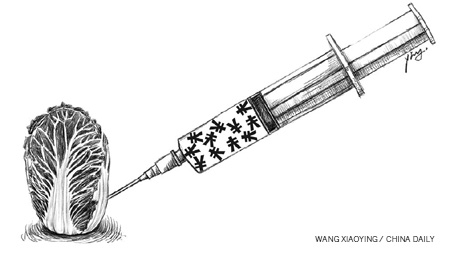
Chinese farmers and consumers are feeling the impact of fluctuating food prices. But instead of relying on just a few crops, farmers in China should diversify the crops they grow. And policymakers and provincial governments should focus on strengthening local markets to ensure that farmers can sell their products to earn enough income to support their livelihoods.
Seventy percent of the world's food supply comes from just three grains - corn, wheat and rice - and 80 percent of our plant-based food intake comes from just 12 plant species - eight grains and four tubers. As markets fluctuate, climate change takes hold and the global population continues to grow, we need to find a recipe for increasing our resilience to these shocks.
Rising wheat prices are affecting the cost of other grains, dairy products and meat in China and the rest of the world. The extreme weather in recent years - excessive snow, droughts and floods - has been the worst in generations and affected the yields of farmers in China, as well as other countries in the region. This has caused the prices of noodles, cooking oil and other food products to rise sharply.
Some food factories which used to mainly produce instant noodles are producing a variety of new products to secure profit amid high wheat prices to avoid being affected by any single factor.


While all crops are vulnerable to risks, researchers have found that vegetables tend to be more dependable than staple crops, because they have shorter cycles, grow faster and require less space. Indigenous vegetables are especially hardy because they are more resistant to pests and diseases than other plants. And they need less irrigation and expensive chemicals, helping small-scale farmers save money.
In China, a recent slump in vegetable prices, too, is hurting farmers. The fall in prices of Chinese cabbage, celery and a dozen other vegetables is forcing farmers to use their rotting vegetable stocks as organic fertilizer or feed for animals. Experts say this is the result of increased production, a focus on a handful of vegetables and unseasonably sunny weather. According to researchers at the economics institute of Shandong Academy of Social Sciences, farmers planted more cabbage because of an increase in demand from South Korea last year, where bad weather destroyed vegetable crops.
There are a number of lessons to learn from this. Small-scale farmers must diversify the crops they grow to cushion themselves against market fluctuations and climate-related crop failure. Linking farmers more directly to local markets and encouraging local consumption will help ensure that demand meets supply. In Shandong, where vegetable farmers have suffered because of falling prices, the provincial government is urging supermarkets and school canteens to buy vegetables locally. In addition, making weather and market information more easily accessible to small-scale farmers can help them plan properly and decide what crops to grow.
Some research groups have already begun improving indigenous crops and making them available to farmers. The World Vegetable Center, for example, breeds enhanced varieties of indigenous vegetables to increase resilience and shelf life. Although vegetables already provide important vitamins and nutrients, such as vitamin A and iron, better quality seeds mean better-tasting and more popular food.
As part of the Worldwatch Institute's Nourishing the Planet project, researchers traveled across sub-Saharan Africa and India unearthing environmentally sustainable solutions to hunger and poverty. Research findings - including innovations in the cultivation of indigenous vegetables - were published in a report titled State of the World 2011: Innovations that Nourish the Planet.
Indigenous vegetables have largely been neglected by agricultural researchers and investors despite their widespread consumption. But organizations like Slow Food International are re-igniting interest in diversifying diets based on local foods, and teaching consumers how to cook different varieties.
Innovative efforts like these can be scaled up and replicated around the world to build a more secure agricultural system, ensuring resilience to food price fluctuations for consumers and farmers alike.
The author is co-project director of Nourishing the Planet project under the Worldwatch Institute, a US independent research institute, and the author of recently released State of the World 2011: Innovations that Nourish the Planet.
| 分享按鈕 |