Industries
Rare-earth supplies expected to grow
By Zhou Yan (China Daily)
Updated: 2011-06-16 09:09
 |
Large Medium Small |
 |
|
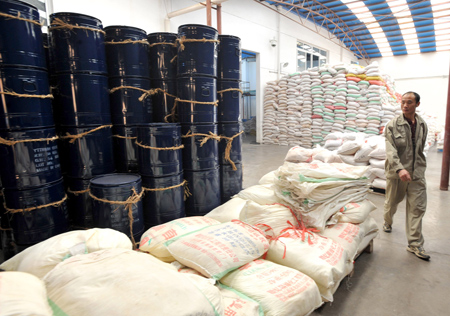
A rare-earth factory in Jiangxi province. Although China is the world's top rare-earth supplier, it controls only about 36 percent of the world's deposits. [Photo/for China Daily] |
High prices will prompt overseas firms to explore resources: Experts
BEIJING - The world's supply of rare-earth minerals will outstrip demand within five years, reversing global reliance on China's exports as more foreign players begin exploration of their own, industrial executives said.
The soaring price of rare earths will also trigger global players to cash in on the valuable minerals.
| ||||


Consequently, "the current tight-supply situation will not last," Wang said. The State-owned NFC has tapped into Guangdong province, the mid-heavy rare-earth-rich region, by teaming up with local firms.
NFC Southern Rare Earth (Xinfeng) Co, in which NFC owns 76 percent equity, received authorities' approval in May to build the world's biggest ion-type rare-earth separation project, with an annual capacity of 7,000 tons.
Rare earth is the collective name for 17 metallic elements, of which the mid-heavy types are the most valuable because of their wide uses. The metals are needed for some advanced technologies, such as smart phones, hybrid cars and missiles.
China, which supplies more than 90 percent of the minerals, adopted strict exploration and export regulations after rampant exploration caused heavy environmental pollution.
Although it is the world's top rare-earth supplier, China controls only about 36 percent of the world's deposits. Countries with large reserves, such as the United States and Australia, have yet to unfreeze exploration of the minerals.
"More countries participating in the exploration of their own supply of rare earths will help ease the tight-supply situation and ease demand," said Chen Zhanheng, director of academic department, the Chinese Society of Rare Earths (CSRE).
According to the association, China produced 118,900 tons of rare-earth minerals in 2010, more than 30 percent higher than its planned quota.
Chen said that China's export quota will be slashed to about 30,000 tons annually in the coming years, after reaching about 35,000 tons in 2010.
According to announced production targets in other countries, a total of 60,000 tons of rare earths will be produced outside China by 2013 and 170,000 tons by 2015.
Overseas demand for rare earths has stood at an average of 50,000 tons annually in the past few years, Chen said. "Global supply of the minerals, particularly the light-type, which exists in abundant deposits overseas, will soon surpass demand, despite China's curbs on the metals," Chen said.
In addition, more profit-driven players will join in the resurgence of exploration as rare-earth prices keep surging to new heights.
The price of neodymium oxide, a type of rare earth mined mostly in China, has more than doubled since early this year to around 820,000 yuan a ton. The price is more than 11 times higher than that in December 2008.
"The surging prices, based on the anticipation of more stringent policies limiting exploration and production of rare earths in China, magnified the actual supply crunch," said Liu Minda, a non-ferrous metals analyst from a brokerage house based in Jiangsu province.
The industry will attract more profit-driven participants and eventually reverse the current tight supply, NFC's Wang said.
Apart from the domestic market, NFC will expand its overseas growth in natural resources by focusing on West Asia, North Asia, and other neighboring countries of China during the 12th Five-Year Plan period (2011-2015), Wang said.
| 分享按鈕 |