Wind power on the rise
Updated: 2011-11-28 09:39
By Liu Yiyu (China Daily)
|
|||||||||||


Lagging grid development may hamper burgeoning industry
HOHHOT - It only takes 60 minutes to fly from Beijing to Hohhot, the capital of the Inner Mongolia autonomous region in North China. However, Hohhot still enjoys an unlimited supply of electricity, while many places in China are facing their most severe power shortages for years.
|
 |
|
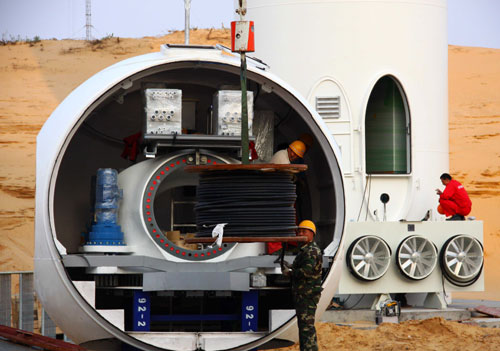
Workers deploying wind turbines at a wind farm in Jiujiang, Jiangxi province. China's installed wind-power capacity has doubled every year since 2005. [Photo/China Daily] |
The resource-rich region of Inner Mongolia is China's powerhouse and produces more electricity than it can consume. This vast region is famous for its abundant resources: It is the country's largest producer of coal and is home to the world's largest rare-earth mine.
Now, it is rapidly becoming known as the wind-power center of China.
Vowing to become the country's upland Three Gorges - the site of a massive hydroelectric dam - the province has set a target of installing 33 gigawatts (gW) of wind capacity by 2015, equal to 20 percent of the region's total power generation.
By the end of June 2011, Inner Mongolia's grid-connected wind capacity had reached 12 gW, or 10 percent of the region's power generation, while the national average in China is 0.7 percent, according to the National Energy Administration (NEA).
This has put the province on a par with the world's leading wind-power countries such as Denmark and Spain.
Chifeng city, 600 kilometers (km) from Hohhot, is an ancient settlement in the east of the region. It is gradually becoming recognized as the world's largest wind-power cluster.
The Dongshan wind plant forms part of a 670-megawatt (mW) wind farm operated by China Datang Corp Renewable Power Co, one of many State-owned wind-power developers.
Dongshan has an installed capacity of 250 mW and has erected 158 wind turbines, each with a capacity of 2 mW, produced by Vestas Wind Systems AS, a leading Danish turbine manufacturer.
The plant generates approximately 650 gigawatt hours (gWh) of power annually. That energy is sold to Northeast China Grid Co Ltd - one of five subsidiaries of the State Grid Corporation of China -through three dedicated transmission lines and a series of substations.
Five years ago, the project was at an impasse. Its developers - the State-owned China Datang Corp, Kyushu Electric Power Co and Sumitomo Corp of Japan - had secured site-development rights, but banks were unwilling to take a risk on the project. The bankers were concerned about the high level of upfront capital expenditure for what was then a relatively new technology in China, and also by the absence of any long-term power-purchasing agreements.
Lured by the huge market potential, Kyushu Electric entered into partnership with Datang to build part of the plant, even though the investment return from wind projects is much lower than that from coal-fired plants, according to the Japanese company.
As one of the few foreign players in China's wind-power market, Kyushu Electric has witnessed the sector's development almost from scratch.
Almost non-existent until a few decades ago, China's installed wind-power capacity has doubled every year since 2005. It increased more than 10-fold from 28 mW in 1996 to 42 gW by the end of 2010, although the share of wind power in the national energy resource is still small.
"Our concern now is that better placed wind sites have been taken by developers, leaving those with relatively poor resources for the later arrivals, which gives investors less return on investment," said Aoyagi Tetsuji, the Japanese head of the joint project.
The Dongshan plant is China's first and only model wind farm - that is, one deemed "grid-connection friendly" - to have met the technical requirements for grid compliance, according to the director, surnamed Bao.
The farm has installed an advanced wind-power forecast system, which can predict potential disruptions and fluctuations in the amount of power available as far ahead as 48 hours.
The other reason that the plant is so "grid-connection friendly" is that all the turbines have a Low Voltage Ride Through (LVRT) capability, a function absent from most wind turbines in China until two major malfunctions earlier this year caused 1,346 turbines to become disconnected from the grid.
LVRT refers to the capability of turbines to maintain continuous operation during and after precipitous dips in voltage, allowing the power grid to be adjusted quickly and improves overall safety and stability.
Efficient operation of the grid requires that a balance between generation and consumption must be constantly maintained to avert the possibility of disturbances in the quality and supply of power.
Major mismatches or interruptions could lead to a system breakdown and power blackouts.