 |
|
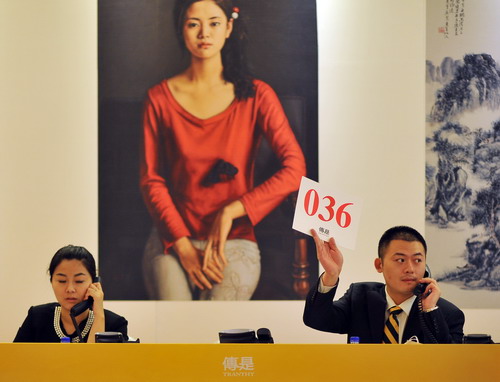
A woman takes a phone bid at Beijing Tranthy's 2012 Spring Auction on May 16. [Photo/ China Daily] |
When Zhao Zhike visited the Shanghai World Expo in October 2010, he stumbled upon Beautiful Asset Management, a Beijing-based company that specializes in the management of art investment funds.
Based on his previous investment experience, Zhao, who runs an international trading business in Beijing, believed art could become a highly profitable tool to hedge against inflation.
Make no mistake, art is big business. Earlier this month The Scream, probably the most famous work by the Norwegian artist Edvard Munch, sold for $119.9 million in New York. That price tag saw the painting become the most expensive work ever sold at auction, despite being one of four copies made by the artist. The other three are all owned by museums in the artist's home country.
After consulting friends and several contacts at BAM, Zhao began to invest in art at the end of 2010. He now puts around 20 or 30 percent of his total annual investment into art funds, equivalent to 2 to 3 million yuan ($317,420 - $475,970).
When traditional investments, such as equities and real estate, were in recession in 2011, art funds prospered as investors sought a hedge against long-term inflation. More than 70 funds have been founded by nearly 30 art investment companies since 2009 with a combined value of 5.77 billion yuan, according to an investigation by the Chinese magazine, Money Journal, at the end of 2011.
"Although the total scale of art investment is still small compared with other funds, it has taken less than five years to realize such a dramatic increase," said Feng Pengcheng, a professor of economics at Beijing's University of International Business and Economics.
Although art investment funds are a relatively new phenomenon in China, they've been used extensively and profitably in other countries. For example, the British Rail Pension Fund was founded in the 1960s when the UK was facing severe currency devaluation. Having consulted senior managers at the auctioneer Christie's, the fund's trustees realized that buying works of art was an effective way of combating inflation and also that the artworks were likely to rise in value, especially once economic stability had been restored.
Rising art investment
However, compared with art funds overseas, those in China have shorter investment periods and also differ in the expected yields and profit distribution, among other aspects.
Data from the National Bureau of Statistics show that China's consumer price index hit 3.3 percent in 2010, rising from minus 0.7 percent in 2009. The country's art investment market rose in tandem with that inflation, especially in terms of auction prices.
According to Art Market Trends, 2010, a report published by Artprice, a renowned data provider, China overtook the United States as the leader in fine art auction sales in 2010, with total revenue of $3 billion, accounting for 33 percent of the global turnover for fine art auction sales. That led to a number of auction houses turning their attention to art investment funds, and financial institutions that were once wary of the market also started becoming involved.
"At present, investment periods in China are relatively short compared with those in developed economies," said Dong Yi, the CEO of BAM, who has a decade of investment experience.
"Art investment funds are suitable for Chinese investors for two reasons. On the one hand, good works of art are too expensive for individual investors. On the other, inexperienced investors may be confused by the market and are likely to require guidance from professionals. There is a group of rich people willing to invest in the market, so those funds have great potential for development," said Dong.
Beijing Bonwin Contemporary Art Investment Co, launched its first art fund in cooperation with China Minsheng Banking Corp in 2007. Setting the entry level at 500,000 yuan, the fund targeted high-end customers and according to a post on the bank's website, investors received a net profit of more than 25 percent just two years later.
Bonwin uses all the available investment models, including financial products, trust plans and private equity, said Huang Yujie, the chairman. He explained that the company's biggest current investment is 400 million yuan, while the smallest is 60 million. The value of its total investment was roughly 1 billion yuan in 2011, and it is slated to reach 3 billion this year.
Just as investors need to refer to the stock market index when trading equities, BAM bases its valuations on the Mei Moses Art Index, established by Mei Jianping, an associate professor of finance at the Stern School of Business at New York University, and Michael Moses, a retired associate professor at the same school. Tracking the trading records of specific art pieces, the index is an objective guide for investors and is rated by Morgan Stanley as one of the 10 most important asset indexes in the world.

Copyright 1995 - . All rights reserved. The content (including but not limited to text, photo, multimedia information, etc) published in this site belongs to China Daily Information Co (CDIC). Without written authorization from CDIC, such content shall not be republished or used in any form. Note: Browsers with 1024*768 or higher resolution are suggested for this site.
License for publishing multimedia online 0108263 Registration Number: 130349