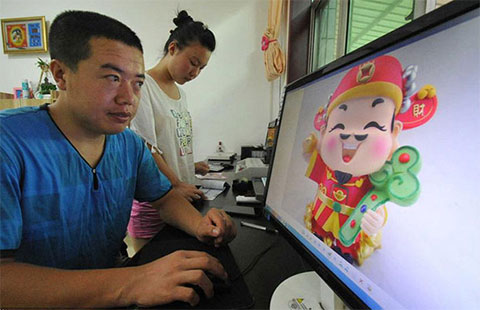
The power of culture is usually soft and intangible, but it can become hard and tangible when it integrates with industry. The Cool Japan Strategy shows how Japan is trying to realize better integration of its culture and industries.
The Cool Japan Strategy aims to boost domestic demand and improve the promotion and sales of cultural exports by promoting the nation's creativity-based industries both at home and overseas.
The strategy plans to increase Japanese creative industries' share of the world market from the present 2.3 trillion yen ($30 billion) to 8-11 trillion yen in 2020, when the size of the world market for culture industries will be an estimated 900 trillion yen. By promoting the overseas development of small and medium-sized businesses, attracting tourists to Japan and revitalizing local communities, the strategy intends to promote employment.
Specifically, the strategy focuses on promoting Japanese fashion, food culture, regional specialties and design skills, as well as tourism, as major means to increase the added value of these culture elements.
For example, about 9,000 restaurants in the United States advertise themselves as serving Japanese food (2.5 times as many as 10 years ago). But Japanese-owned restaurants account for less than 10 percent. So there is great potential to turn Japanese cuisine into a revenue source.
It is not difficult to see that the two major characteristics of the Cool Japan Strategy are the integration of culture and industry and the expansion of the world market for Japanese cultural products.
Specifically, the strategy plans to promote the cooperation between Japanese enterprises and their Chinese counterparts to promote the sale of Japanese products and the reputation of Japanese design and products in the Chinese market. It also has specific plans to develop Japanese food brands in Singapore and the United States. It even has a plan to promote its fashion, food, toys and stationery in India.
This may provide some food for thought when considered alongside China's plan for the development of its cultural industry. There is nothing wrong with its focus on providing more quality cultural products for residents. It is also absolutely necessary to promote culture with a view to improving the overall quality and civic awareness of residents.
But what struck me the most about the Cool Japan Strategy is its clear vision of the future, when the integration of culture and industry will turn out to be increasingly important for a country to turn soft power into a source of revenue. This is where the guidelines of China's cultural development plan need to materialize in a detailed way. Careful studies need to be conducted on the advantages of Chinese culture and the potential for its contents to be integrated with industries.
For example, Chinese food is famous all over the world. But I've never seen a single survey about how much money Chinese catering enterprises can make from its branches overseas. Neither have I seen any plan for innovations to improve the Chinese food and create a particular brand in a particular country or region.
I am shocked when I read in the Chinese papers that some Chinese local governments plan to invest huge amounts of money in building theaters with a view to developing cultural industries. Why should our local governments' first thought be to spend money whenever there is a national plan calling for the development of a particular industry?
Why can't they sit down and think about how the plan should be developed in a way that the biggest benefit can be created with the least money spent? Why can't they have a creative plan of their own to innovate and blaze a new trail?
I don't know. But I know by studying the Cool Japan Strategy that we need leaders at various levels who have a vision for the future and thus can organize talented experts to make long-term plans for the development of cultural industries.
Last but not the least, cultural industries should be made to develop on their own rather than being financially supported by the government. The role the government plays is to make policies and provide policy support.
The author is a senior writer with China Daily. E-mail: zhuyuan@chinadaily.com.cn

Copyright 1995 - . All rights reserved. The content (including but not limited to text, photo, multimedia information, etc) published in this site belongs to China Daily Information Co (CDIC). Without written authorization from CDIC, such content shall not be republished or used in any form. Note: Browsers with 1024*768 or higher resolution are suggested for this site.
License for publishing multimedia online 0108263 Registration Number: 130349