

 Comments()
  Print
Print  Mail
Mail  Large Medium Small
|
 |
|
Monks from China and Japan ring a bell for peace at a memorial to the victims of the Nanjing Massacre on Dec 13, 2011, the 74th anniversary of the outrage. [Photo/China Daily] |
|
 |
|
Some of the 200 students from the Chinese mainland, Taiwan and Japan at a mass 18th birthday party in Beijing. [Photo/Xinhua] |
|
 |
|
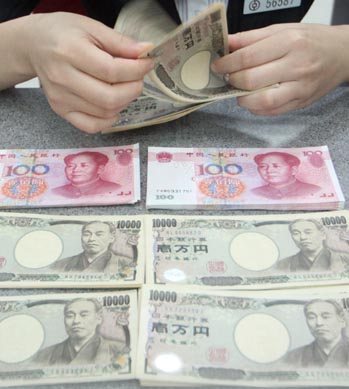
Japan and China began direct trading of their currencies on June 1 in Shanghai and Tokyo, as part of their efforts on currency cooperation to boost the integration of Asian economies. [Photo/Xinhua] |
Greater economic integration widely supported, Li Xiaokun and Cui Haipei report in Beijing.
Despite the ongoing European debt crisis that roils the global economy, many people in Asia still expect to see the formation of a regional economic bloc.
That's the view in China, at least, according to the findings of an annual survey on Chinese and Japanese perceptions of each other. The survey, published on Wednesday, divided respondents into two groups: "Common", mainly those with a basic level of education, and "Intellectual", those with a university degree or higher qualification.
Nearly 50 percent of Chinese people in the former category, and an increasing number of students, believe that an economic grouping similar to the European Union will eventually emerge in Asia.
The optimistic mood was also reflected in perceptions of the future of the Chinese currency, with a majority of respondents believing that the yuan will dominate Asia and could even replace the US dollar as the major currency for trade.
However, the report also indicated that the people of Japan, the world's third-largest economy and a major mover in the proposed East Asian economic community, are more conservative on the issue.
The survey has been conducted simultaneously in both countries for the past eight years. This year 1,627 Chinese were surveyed in five cities - Beijing, Shanghai, Chengdu, Shenyang and Xi'an - as well as 1,003 university students and teachers at five of the country's most prestigious universities, which are all situated in Beijing. In Japan the survey garnered responses from 1,000 common members of the public and 600 intellectuals.
Despite the current woes affecting Western economies, almost half of common Chinese respondents, 48.9 percent, believe that an Asian economic bloc will be established at some point.
There was also notable surge in the number of Chinese intellectuals who supported the idea, 27.1 percent, compared with 2011 when the number was 19.3 percent. A pessimistic attitude was still dominant overall, though.
In sharp contrast, about 43 percent of ordinary Japanese and 65 percent of intellectuals said they did not believe that Asia's economies will devolve into a bloc, and previous surveys have indicated that Japanese nationals have long questioned the necessity of such a union.
According to the Japanese Ministry of Finance, the trade volume with China hit a record $349.38 billion in 2011, making China the country's largest trading partner. Meanwhile, a milestone investment agreement between Beijing, Tokyo and Seoul was signed in May. The accord followed 13 rounds of talks since 2007 and paved the way for negotiations on the establishment of a free trade agreement between the countries.
Qu Xing, director of the China Institute of International Studies, said an FTA could help to lower regional tensions and might eventually lead to a more integrated Northeast Asia and possibly even a joint currency. "It might be a breakthrough in solving regional disputes," he said.
The differing views on the future of the Asian economic bloc held by Chinese and Japanese people are heavily influenced by the different policies implemented by Beijing and Tokyo, according to Huang Dahui, a professor at the School of International Studies at Renmin University of China. "It is apparent that China has been much more active in that regard, and regional integration is the inevitable trend," he said.
However, compared with Europe, Asia is lagging behind, said Huang. "But the integration of East Asia does not have to follow the approach taken when the EU came into being. Development here is not balanced and cultural and historical problems are the main factors restraining development," he said, adding that the future of regional integration will be affected by a great many unknown factors.
"Japan is also concerned that it will be marginalized if the FTA helps China to become even stronger," said Zhou Yongsheng, professor of Japanese studies at China Foreign Affairs University.
That view was echoed by Shen Shishun, an expert on Asia-Pacific studies with the China Institute of International Studies, who added that Tokyo fears that industries such as agriculture may be affected by the shadow of a rising China. "So the chance of seeing the establishment of a regional FTA in the short term is almost zero," he said.

 Michelle Obama addresses at Democratic National Convention
 Slides of Yanbian: place, people and prosperity
 Washington to remain focused on Asia-Pacific
 RQFII target blue chips amid bear market
 Australian recall for top two exporters
 China fears new car restrictions
Copyright 1995 - 2010 . All rights reserved. The content (including but not limited to text, photo, multimedia information, etc) published in this site belongs to China Daily Information Co (CDIC). Without written authorization from CDIC, such content shall not be republished or used in any form. Note: Browsers with 1024*768 or higher resolution are suggested for this site.
License for publishing multimedia online 0108263 Registration Number: 20100000002731