
 Comments()
  Print
Print  Mail
Mail  Large Medium Small
Many Chinese goods traditionally regarded as cheap but poor quality
It is not a sprint but a marathon for Chinese manufacturers to get rid of some tainted labels on made-in-China products. In addition to continuous innovation, new marketing strategies are needed to upgrade their reputation, analysts said.
From slippers and socks to consumer electronic products such as personal computers, made-in-China goods appear in every corner of the world. They win markets with scale, but also suffer a reputation of "low price and low quality" as a byproduct.
This perception has upset some China-based, globally operating manufacturers, whether they admit it or not.
|
 |
|
John Bryson (second from left), US secretary of commerce, at the 22nd US-China Joint Commission on Commerce and Trade in Chengdu, Sichuan province, on Nov 21, 2012. Bryson encouraged Chinese business leaders to invest - by establishing factories, facilities, operations and offices - in the United States, the largest consumer market in the world. More than 5 million Americans are directly employed by foreign companies in the United States, he said.?[Photo/Agencies]? |
Haier Group, one of the most successful companies originating in China, which sells appliances and electronic goods across the world, revealed the embarrassing fact in a Financial Times report that most of its international customers do not know it is a China-based company.
Haier, headquartered in Qingdao, Shandong province, already has the biggest share of the world's appliances and electronic goods market. Its revenue was about $23.7 billion last year, giving it a 7.8 percent share of the global market in that sector. Overall, 26 percent of its turnover comes from overseas.
Li Pan, managing director of Haier's overseas division, told the UK newspaper: "We don't deny it but we don't emphasize it."
In fact, some of the multinational company's products are from its manufacturing facilities overseas.
But avoiding the sensitive issue does not help solve problems. To improve the widespread image of made-in-China products on the global stage could be a better way for the sustainable growth of Chinese brands, analysts argued.
Andrew Phillips, managing vice-president of research firm Gartner Inc's Beijing office, said China-based companies routinely market and export electronic products to developed economies that are sold at a low price in order to gain market share and "presence".
Take mobile phones for example. China is the world's biggest manufacturing base for handsets. In 2011, the country shipped more than 1.13 billion cellphones, accounting for about 71 percent of the total handset number in the world, according to the Ministry of Industry and Information Technology. The figure was 19 percent in 2001 and 40 percent in 2006.
A majority of mobile phones manufactured in China are sold abroad. More than 90 percent of Chinese-branded devices are targeted at low-end clients, said Sun Wenping, secretary-general of the Shenzhen Mobile Communications Association. Shenzhen is the largest mobile phone production base in China by shipment and home to companies such as Huawei Technologies Co, ZTE Corp and TCL Corp.
|
|
|
|
 |
But building brand strength outside China is not totally dependent on a high volume of export sales. Chinese brands are inevitably "pre-associated" with low quality (outside China) and low-end branding tends to reinforce this, he said.
In order to reverse the tainted labels of made-in-China goods, Phillips suggested Chinese manufacturers select their most reliable products, rather than the cheapest, and market them as value for money, which helps align the products with the majority of buyers in developed economies.
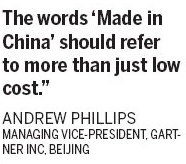
"The words 'Made in China' should refer to more than just low cost," he said.
More and more Chinese companies, as they ambitiously dream to develop their own brands and make a dent in the global market, have echoed Phillips' idea by starting to introduce mid- to high-end products to foreign markets.
Huawei Technologies Co and ZTE Corp, two Shenzhen-based telecom equipment makers that recently devoted huge resources to developing mobile phones, have started to launch flagship handset models to compete in the same league as Apple Inc's iPhones and Samsung Electronics Co's Galaxy series.
Huawei unveiled its first elite flagship smartphone - the Android-running Ascend P1 - in April this year in the hope of attracting attention from high-end customers across the world. The company put on various events, invested a lot of money in advertisements in major cities including London and New York and hired a world-class designer from BMW to be its mobile phone design director to cater to the tastes of overseas buyers.
Huawei even sponsored the 2011 Italian Supercoppa (Super Cup) to the tune of about 100 million yuan to attract the attention of both domestic and European football fans to its mobile phones.
"We are planning to have a broader portfolio. The high-end smartphone will boost Huawei's reputation greatly and help branding," said Wang Weijun, China president of Huawei Device Co Ltd.
ZTE, the world's fifth mobile phone vendor by 2011 revenues and the world's fourth-largest mobile phone manufacturer measured by 2011 unit sales, also started to focus on mid- to high-end smartphones in order to establish branding both at home and abroad.
He Shiyou, executive vice-president of ZTE, said the company aims to at least double smartphone shipments this year to more than 30 million. The percentage of mid- to high-end smartphones will also double.
Meanwhile, some Chinese companies are exploring online channels, including social networks such as Facebook and video websites such as YouTube, to help customers to get a better understanding of their products. Haier opened its official channels on YouTube in five European countries this year. Visitors can watch about 50 video clips on Haier's products.
For post-sales problems, Phillips at Gartner suggested Chinese brands should establish local service and repair facilities with qualified technicians.
He said: "Customer satisfaction in this area can significantly aid brand-building activities."
shenjingting@chinadaily.com.cn?

 Michelle Obama addresses at Democratic National Convention
 Slides of Yanbian: place, people and prosperity
 Washington to remain focused on Asia-Pacific
 RQFII target blue chips amid bear market
 Australian recall for top two exporters
 China fears new car restrictions
Copyright 1995 - 2010 . All rights reserved. The content (including but not limited to text, photo, multimedia information, etc) published in this site belongs to China Daily Information Co (CDIC). Without written authorization from CDIC, such content shall not be republished or used in any form. Note: Browsers with 1024*768 or higher resolution are suggested for this site.
License for publishing multimedia online 0108263 Registration Number: 20100000002731