
 Comments()
  Print
Print  Mail
Mail  Large Medium Small
At first glance, Jincheng appears to be a typical coal-mining city.
The city in the southeastern part of Shanxi province boasts one-fourth of China's reserves of anthracite, or smokeless coal. Jincheng produced 50 million metric tons of anthracite in 2011, accounting for 15 percent of the nation's total.
But Jincheng is atypical, if a few other statistics are taken into account.
|
 |
|
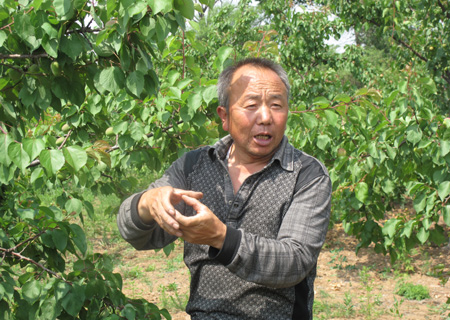
Fruit grower Shen Yuxi talks about the harvest in his orchard in Jincheng, Shanxi province, in May. [Photo/China Daily] |
About 39 percent of the city is covered with forest, 23 percentage points higher than the national average.
"Blue-sky days", an indicator used in China to show air quality, numbered 354 last year, 95 more than the city had in 2005.
The city also boasts the highest biodiversity in the province. About 80 percent of the Shanxi's plants and 70 percent of its animals are in Jincheng, which accounts for only 6 percent of the province's territory.
As recently as the 1980s, the city was no different from any other major coal city. Dust and smog were part of the city, which has been mining coal for 500 years. At the time, the forest coverage rate was 16 percent, said Wang Antai, vice-director of the Jincheng forestry bureau.
In 2007, China had 118 cities that saw resources such as coal and copper depleted after years of exploitation, according to the National Development and Reform Commission.
Those cities have a total of 154 million people, more than one-10th of China's population. Most of the cities are looking for new ways to fuel their economies after years of easy money.
They could learn a thing or two from Jincheng.
Although Jincheng still boasts a large reserve of coal, it started to transform its economic model in the 1980s as the government gradually reduced the reliance on the "black gold" to encourage the forestry industry.
An environmental compensation mechanism was also established to require coal producers to pay for green initiatives, a model that set an example for China's resources-rich cities.
"In fact, the green economy is more sustainable and profitable than the resources economy," Wang said. "The black-to-green transition will not slow down the economy, either."
Forestry makes a fortune that is no smaller than coal, according to Shen Yuxi, who owns more than 30 hectares of forest that includes fruit and walnut trees.
"Farmers have been encouraged to plant cash trees since the 1980s," he said. "We can get 300 yuan ($47) of financial aid from the government for each mu (0.07 hectare) of walnut trees, and 1,000 yuan for each mu of forsythia trees, a traditional Chinese herbal medicine plant."
The subsidy to farmers comes partly from the tax levied on coal producers.
Coal-mine owners have to pay 10 yuan for each ton of coal they mined. They are also required to turn land into forest and take care of it.
Because of these policies, about 90 percent of mountain land that was left barren by mining is now covered with greenery, Wang said.
Coal producers are happy with the policy because they make money from the trees they plant, Wang added.
Zhang Yuejin, a coal-refinery factory owner in his 50s, said he might eventually become a farmer but not a coal-business owner. He now invests half of his income in walnut trees.
"The earnings (from trees) are good, stable and, more importantly, environmentally friendly and sustainable," he said. "I think green is the way to go."
Another way the Jincheng government encourages farmers to plant trees is by buying their forest.
In 2011, it spent about 40 million yuan, out of its 18.18 billion yuan fiscal revenue that is mostly earned from the coal industry, to buy the forest ownership from farmers.
The output of the city's forestry industry hit more than 800 million yuan in 2011, four times that of 2005.
The improved environment attracted a group of high-tech companies and talents to the city.
For example, Foxconn Technology, the Taiwan contract manufacturer that makes iPhones, announced last year it will spend 100 billion yuan to build a manufacturing base in Jincheng.
"That marks another leap forward in Jincheng's transformation of its growth model. We are striving for resources not only from forestry, but other sustainable industries such as high-tech," Wang said.
Contact the writers at peipei@chinadaily.com.cn and sunruisheng@chinadaily.com.cn

 Michelle Obama addresses at Democratic National Convention
 Slides of Yanbian: place, people and prosperity
 Washington to remain focused on Asia-Pacific
 RQFII target blue chips amid bear market
 Australian recall for top two exporters
 China fears new car restrictions
Copyright 1995 - 2010 . All rights reserved. The content (including but not limited to text, photo, multimedia information, etc) published in this site belongs to China Daily Information Co (CDIC). Without written authorization from CDIC, such content shall not be republished or used in any form. Note: Browsers with 1024*768 or higher resolution are suggested for this site.
License for publishing multimedia online 0108263 Registration Number: 20100000002731