Excessive economic growth will only harm the labor market, leading to rises in pay and the price of agricultural products
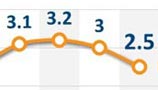
Predictably, opinions about the Chinese economy varied after it was announced that the country's GDP increased at a rate of 7.6 percent in the second quarter of the year. Optimists said the rate was even better than expected. Pessimists, though, claimed it was a sign that the Chinese economy is in danger of having a hard landing.
For my part, I believe that a growth rate of 9 percent is a little high for China, that 8 percent is desirable, and, if the rate slows down to 7 percent, that's not a "big deal".
Recently, the International Monetary Fund again altered its predictions for the economies of most countries in the world, saying it expects them to grow at a slower pace than it had previously forecast. As the effects of the eurozone crisis linger, many governments continue to be burdened by colossal debts. Meanwhile, the so-called fiscal cliff in the US - a combination of tax increases and spending reductions expected to result in a slowing of the country's economy - has raised many uncertainties.
As a result of this economic turbulence, emerging markets around the globe have seen their economic growth decelerate remarkably. China is also undergoing a readjustment in its real estate market.
If we are to prevent the current real estate bubble from expanding and avoid disaster, we need to ensure that the market has a soft landing.
Yet, we shouldn't forget that, if we really want to regulate the housing industry, we'll simply have to swallow the resulting economic slowdown. As everyone knows, you can't have your cake and eat it too. It's unreasonable to think one can see a simultaneous decrease in house prices and acceleration in economic growth.
We should also keep an eye on inflation, of which between 70 and 80 percent in China stems from increases in food prices. Recently, the US has been suffering from its worst drought in 25 years and the UK from its worst in 30 years. France has decided to restrict the use of water on almost a third of its land and Germany, which is the source of the second largest amount of wheat among all European countries, has been forced to lower its wheat production by 10 percent. A recent article in the newspaper Financial Times said the world economy is at risk from inflating food prices.
Some contend we should combat unemployment by maintaining a high rate of economic growth. Yet, labor remains in short supply in the country.
In these circumstances, excessive economic growth will only lead to wage increases and greater shortages in the labor supply. That, in turn, will drive the price of Chinese agricultural products upward.
No matter how one looks at the situation, then, it's nearly impossible to expect economic growth to proceed at an extremely fast pace this year.
As long as the country's growth rate for the second half of the year is above 8 percent, we can guarantee that GDP growth will likewise proceed at a rate of 8 percent for all of 2012. In 2011, China's total GDP was 46 trillion yuan ($7.24 trillion). Starting from that base, we need to only increase our economic growth rate by 0.5 percentage point, or 120 billion yuan, to achieve that target of 8 percent. If monetary policy could be loosened a bit to encourage investment in fixed assets, such an increase would not be difficult to obtain. There is thus no reason to adopt policies that will intervene greatly in the economy.
Some people still hope China will drive world economic growth. These same people are also often the ones who make a fuss whenever the slightest signs of an economic slowdown appear in China, often seeing them as portending a "hard landing". Yet, they seem to have no clear understanding of what a hard landing is. Is it negative growth, zero growth or growth at a rate of 4 percent? People with the least amount of common sense know that a hard landing in China is very unlikely at this time. If they contend that a growth rate of 7 percent portends a hard landing, they will be uttering one of the most absurd things I've ever heard.
Amid the world economic downturn, China has no capacity or obligation to save the world economy. The country has done well simply by fulfilling its responsibility to maintain a growth rate of between 7 and 8 percent.
Looking forward, we should not expect to see the return of a double-digit growth rate. As a result of a series of policies, coupled with reforms related to the distribution of income, workers' pay is expected to increase more quickly.
If we don't make prudent adjustments to monetary policy, inflation will be the result. That, in turn, will hinder economic development.
Furthermore, a loose macroeconomy can leave more room for future structural reforms. Therefore, in my opinion, a growth rate of 9 percent is a little high for China, 8 percent is desirable, and if growth slows down to 7 percent, that's still not a "big deal".
The author is counselor of the State Council, executive vice-chairperson and president of YouChange University. www.chinausfocus.com

Copyright 1995 - . All rights reserved. The content (including but not limited to text, photo, multimedia information, etc) published in this site belongs to China Daily Information Co (CDIC). Without written authorization from CDIC, such content shall not be republished or used in any form. Note: Browsers with 1024*768 or higher resolution are suggested for this site.
License for publishing multimedia online 0108263 Registration Number: 130349