China has the world's largest cement industry with 3,800 cement producers and more than 2.9 billion tons of cement production capacity, which accounts for more than half of the world's total.
However, a slowdown in China's economy, which is predicted to grow at an average annual rate of 7.5 percent between 2011 and 2015, is likely to result in shrinking investment in housing and infrastructure, thus oversupply of cement is getting more and more serious.
|
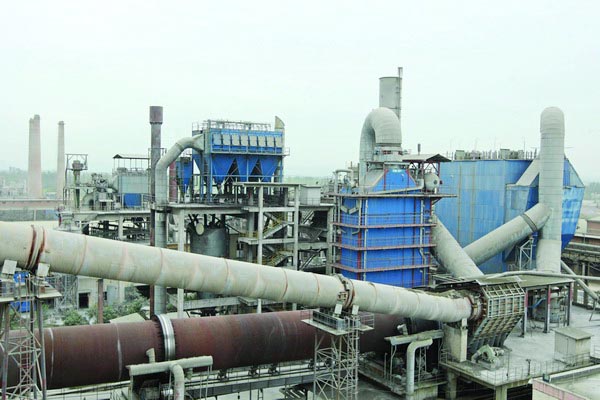 An idle cement factory in Huaibei, Anhui province. Economic slowdown in China resulted in shrinking investment in housing and infrastructure as well as an oversupply of cement. [Photo/China Daily] |
"With the rebalancing of the economy, it is crystal clear that the golden era for the cement industry is gone. But the tough times will reshape it into a more sustainable and quality-focused industry in China," said Lei Qianzhi, president of China Cement Association.
The number of cement producers in China has decreased to 3,800 over the past two to three years due to mergers and acquisitions. The top 10 cement makers in China have a 25 percent lock on production capacity in the nation, up from 15 percent in 2005. The top makers are expected to have a 35 percent market share by 2015, the 12th Five-Year Plan said.
Thanks to mergers and acquisitions, China National Building Materials Group Corp, with businesses in cement and other construction materials, was ranked 485th in the Fortune 500 list in 2011. It became the first Chinese building materials company to appear on the list. The company consolidated 154 small and medium-sized companies in eastern China over the past three years into its South Cement Co Ltd based in Shanghai. The conglomerate produced 138 million tons of cement last year.
CNBM Vice-President Cui Xingtai said in March that the group aims to increase its cement production capacity from 300 million tons a year to 500 million by 2015.
In the newly released list of the Global Fortune 500 in 2012, CNBM climbed to 365th place with $30.02 billion in revenue in 2011. Holcim was placed 474th with $23.38 billion and Lafarge was 480th with $22.97 billion.
"Through M&As, major players are able to control larger markets. By getting rid of outdated capacity and smartly reducing the actual production volume, cement can be sold at a better price. Price wars will not be as frequent," said Sun Tieshi, vice-president of China Building Material Federation.
But not every company in this capital-intensive industry is able to purchase hundreds of cement factories to increase their competitiveness. Western players in the nation's cement industry are focusing on sustainable development in the construction industry to get ahead.
Sang Kang, CEO of Lafarge Shui On Cement, a joint venture between Lafarge and Hong Kong-based Socam Development Ltd, told China Daily that the company will look to accelerate its development in sustainable construction in China. Faced with overcapacity, he said, companies that can upgrade their production models can better survive a downturn.
He views China as one of its key markets. The nation contributed 6 percent of Lafarge's global revenue in 2011, up from 2.4 percent in 2006.
Lafarge opened its first overseas sustainable construction development laboratory in Chongqing last September to develop new and advanced construction materials, products and solutions for its customers in China.
The company is currently producing dust-free cement, and a product line of concretes that it claims provides more strength and durability.
China is one of Holcim's top markets in the world, contributing more than 20 billion Swiss francs ($21.69 billion) in 2011. Senior executives from the company reckon cement demand in China has already reached its peak.
"The current market is flat. As the market continues to flatten, the nature of competition will change. The values of sustainability and environmental performance will play a much bigger role for a company's further development," said Ian Thackwray, Holcim's president for Asia-Pacific and South Africa.
The company entered China in 1995 and formed a strategic partnership with Hubei-based Huaxin Cement Co Ltd, which is one of China's oldest cement companies with a history of more than 100 years.
By investing in Huaxin, Holcim became the Chinese company's largest shareholder with 39 percent of its total shares in 2008.
The partnership has helped Huaxin Cement to achieve a steady annual growth of 30 percent in revenue over the past eight years. It had a capacity of 60 million tons last year, ranking the company in the top 10 among Chinese cement enterprises.

Copyright 1995 - . All rights reserved. The content (including but not limited to text, photo, multimedia information, etc) published in this site belongs to China Daily Information Co (CDIC). Without written authorization from CDIC, such content shall not be republished or used in any form. Note: Browsers with 1024*768 or higher resolution are suggested for this site.
License for publishing multimedia online 0108263 Registration Number: 130349