Comments()
  Print
Print  Mail
Mail  Large Medium Small
Decision signals protectionism and hinders development of new energy industry, says spokesman
The Ministry of Commerce on Thursday condemned a US decision to slap duties on billions of dollars worth of Chinese solar energy products, saying the step "signals protectionism" and "hinders the development of new energy".
|
 |
|
A solar panel production line in Lianyungang, Jiangsu province. The US has decided to impose punitive tariffs on imports of Chinese solar panel products. [Photo/China Daily] |
Shen Danyang, Commerce Ministry spokesman, said the US Commerce Department had ignored reasoning from the Chinese government and enterprises by imposing duties on solar cells made in China.
"The US decision runs counter to global efforts to combat the challenges of climate change and energy security and breaks the country's promise not to take fresh protectionism measures, which was made at the G20 summit," Shen said.
He urged the United States to halt trade remedies to deal with its economic issues in order to encourage communication and cooperation that will push forward industry development.
Shen made the remarks after the US Commerce Department affirmed steep tariffs on Chinese solar panel imports on Wednesday, ranging from 18.32 percent to 249.96 percent, after judging that solar panel production was being made artificially cheap by unfair subsidies from the Chinese government, resulting in "dumping" in the US market.
The US also set additional countervailing duties ranging from 14.78 percent to 15.97 percent to combat Chinese government subsidies, significantly higher than preliminary levels.
For some Chinese companies, the anti-dumping tariffs are slightly lower than preliminary tariffs announced in May. But the Commerce Department has increased more than threefold the anti-subsidy duties that will be imposed on these companies.
The Wuxi-based Suntech Power was given a tariff of 31.73 percent, and the Changzhou-based Trina Solar Energy received a tariff of 18.32 percent.
US imports of solar cells from China were valued at an estimated $3.1 billion in 2011, according to the US Commerce Department.
The US International Trade Commission, or the ITC, is scheduled to make its final decision by Nov 23.
If it affirms that these products cause material injury or threats to US industry, the country's Commerce Department will issue an anti-dumping duty and countervailing duty orders. If the ITC concludes there is no threat, the investigation will end.
Gao Jifan, chairman and chief executive officer of Trina Solar ltd, said the company will consider whether it is necessary and prudent to appeal the final decision of the Commerce Department or the ITC.
"Although we disagree with the conclusions in this case, we will abide by their decision and look forward to the ITC's final ruling in November," he said.
"We are a strong, resilient company and we will continue to innovate, drive technological advances and bring clean energy to the US and the world."
He added that he appreciated the support of US customers and business partners and hoped the final resolution of the case would help the company grow its North America business.
Some industry observers have said tariffs could worsen already-tense trade relations between China and the US.
"It will inevitably lead to a rhetorical rebuke from Beijing and a reminder that China is challenging US anti-subsidy policy at the World Trade Organization and in US courts," said White & Case International Trade Attorney Scott Lincicome, who is the author of a Cato Institute paper on US subsidy and countervailing duty policy.
The tariffs ruling on China was brought on by SolarWorld Industries America Inc, the US subsidiary of a Germany-based producer of photovoltaic cells and modules. Last October, SolarWorld filed a complaint to the Commerce Department, claiming that Chinese manufacturers were able to sell their goods cheaply using subsidies from their government.
Jigar Shah, president of the Coalition for Affordable Solar Energy, said the anti-dumping duties were "a bad decision".
The coalition was formed last year by a group of US solar developers and installers to oppose anti-dumping duties.
He said that the tariffs will not help SolarWorld. Many Chinese mainland manufacturers are now buying solar cells from Taiwan, Malaysia and elsewhere.
The latest US ruling is not much different from the preliminary decision, which was within most people's expectations, said Gao Hongling, deputy secretary-general of the China Photovoltaic Industry Alliance.
"Some Chinese company leaders and industrial insiders were optimistic, but there were no surprises," she said.
"Considering the economic situation in Europe and India, the result is pretty reasonable."
The tariffs only apply to solar cells and modules made on the Chinese mainland.
Aaron Chew, a senior analyst at investment firm Maxim Group in New York, said the tariffs will have a minor impact on Chinese manufacturers.
"The irony is, all the major players in the Chinese mainland solar industry, such as Suntech Power Holdings, have figured out a way to work around the tariffs. They are going to buy cells from Taiwan," Chew said.
"The tariffs will only hurt those solar businesses that bought Chinese modules and cells between mid-December and mid-March. Those guys will not get their money back."
According to the final decision, the punitive tariffs are imposed on panels produced in China. Previously, many insiders noticed a loophole that allows Chinese companies to establish factories outside of China and produce solar panels for export to overseas markets.
However, according to Gao, this loophole is likely to be closed.
"It is true that many Chinese companies are considering expanding their overseas businesses including buying companies or building factories abroad," she said.
The US appears to have considered this possibility, she said, and is likely to block loopholes with additional requirements tagged onto tariffs.
Marco Mangelsdorf, co-founder of ProVision Solar Inc, a company in Hawaii that designs and installs rooftop solar panel systems, said his business has been "hurt deeply" by the solar tariffs levied on China.
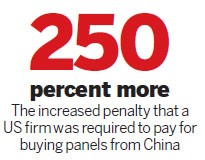
In June, he received a tax bill from US Customs, saying he owed more than $138,000 for having purchased Chinese-made modules earlier this year. The penalty is 250 percent more than he paid for his supply of panels from China.
"The tariffs are not good for anybody. Trade relations between China and the US will definitely go downhill," he said.
Some critics have suggested SolarWorld, the largest producer of solar panels in the US, built its business on the back of financial support from Germany and the US.
Barry Broome, president and CEO of the Greater Phoenix Economic Council, called the tariffs "a short-sighted policy".
"SolarWorld claimed that Chinese manufacturers received loans allowing them to sell their products cheaply. This is hypocritical. SolarWorld is heavily incentivized in its country," Broome said.
Between 2003 and 2011, the German manufacturer received more than 137 million euros ($176 million) in government aid, according to the Center for Solar Research.
Contact the writers at atung@chinadailyusa.com and dujuan@chinadaily.com.cn

 Toyota to recall 1.4m cars in China
 Overseas energy projects get green light
 Use of RMB as settlement currency rise
 Daimler starts new $2.4b plant
Copyright 1995 - 2010 . All rights reserved. The content (including but not limited to text, photo, multimedia information, etc) published in this site belongs to China Daily Information Co (CDIC). Without written authorization from CDIC, such content shall not be republished or used in any form. Note: Browsers with 1024*768 or higher resolution are suggested for this site.
License for publishing multimedia online 0108263 Registration Number: 20100000002731