Over the past few years, clothes affixed with the label "Made in China" have slowly lost their ubiquitous appeal. Clothes labeled "Made in Vietnam" or "Made in Indonesia" now crowd the number of choices available to consumers.
One major reason for the change is the lower labor cost in many Southeast Asian countries, which collectively threaten China's position as the biggest manufacturer of textiles.
"The biggest advantage of Southeast Asian countries in the textile industry is their low labor costs. The monthly salary is almost one-10th that of a Chinese worker," says Zhang Wenshan, a professor at the China-ASEAN Studies Institute of Guangxi University.
While Zhang might be stretching that yarn a bit, a district known as China Textile City in the township of Keqiao in Zhejiang province is looking to simple technological innovations that could distance the country from its Southeast Asian counterparts.
Though the textile industry in China is suffering from declining global demand and the increasing costs of labor and raw materials, China Textile City, located in Shaoxing county, has done its share, with a record high in sales of more than 40 billion yuan ($6.4 billion; 4.9 billion euros) in the first half of this year, according to the China National Textile and Apparel Council.
The average monthly salary of a Chinese worker is about 3,500 yuan a month compared with 700 yuan a month for a worker in Cambodia.
But "apart from (the wide difference in labor costs), there is a large gap in techniques and facilities (in Southeast Asia) compared with their Chinese counterparts, so the priority for Chinese companies is to become more advanced in their techniques so that Southeast Asian countries cannot catch up within a short time," Zhang says.
Shou Lumin, deputy director of the Construction and Management Committee of China Textile City, says local authorities are not worried that Southeast Asian countries will be a threat to Shaoxing's textile industry. "It is true that low labor costs are essential to a labor-intensive industry like textile, but the industry has long passed the phase of pursuing quantity. Nowadays foreign customers pay more attention to the quality and creativity of products, in which we are much stronger."
To maintain competitiveness, Shaoxing county is making efforts to use advanced technology. On Oct 8, the county invited six members of the Chinese Academy of Engineering, a top engineering research body in China, to visit its textile companies.
The experts evaluated the companies in aspects of textile materials, facilities, environmental protection measures and creative designs. The move is regarded as one of Shaoxing's determination to improve its textile industry through technological innovations.
"Shaoxing's textile companies have been very competitive in the world for decades, and I am glad to see that an increasing number of companies are paying attention to advanced technology," says Zhou Xiang, a member of CAE and an expert in textile chemical and dyeing.
She says she is willing to sharing her knowledge in developing environmentally friendly fabrics with Shaoxing's companies. She adds that her research team will establish some research projects with local companies.
"I see many companies with the potential and determination, and it is a mutually beneficial opportunity to combine academic research with actual production," Zhou says.
Dyeing is one of most complicated and highly polluting procedures in the textile industry. Zhejiang R.G.B. Textile Printing and Dyeing Co recently bought a digital printing machine from Austria for 6.8 million yuan to print 400 meters of cloth within an hour, almost three times more than common machines used today.
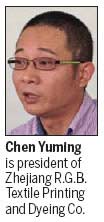
"The advantage of digital printing is that all designs can be done through computers, which saves on labor costs. Also, the polluted water and gas it will cause is almost zero. As far as I know, there are only four such machines in China now," says Chen Yuming, Zhejiang R.G.B. president.
Chen says the company devoted 10 million yuan last year to innovations and 30 researchers to research and development. "Technology is the engine of the development of any industry. With improvements in technology, I have saved labor costs, cut out unnecessary production links and the added design innovations have won me more orders."
Chen's company produced 52.67 million meters of fabric last year with sales revenue of 420.8 million yuan. Chen says 80 percent of the company's products are sold to the Middle East and Europe. "Clients in the Middle East care about the quality and design of the fabrics a lot. They have money and they want the best. This is what Southeast Asian companies cannot offer," he says.
yanyiqi@chinadaily.com.cn


Copyright 1995 - . All rights reserved. The content (including but not limited to text, photo, multimedia information, etc) published in this site belongs to China Daily Information Co (CDIC). Without written authorization from CDIC, such content shall not be republished or used in any form. Note: Browsers with 1024*768 or higher resolution are suggested for this site.
License for publishing multimedia online 0108263 Registration Number: 130349