
 Comments()
  Print
Print  Mail
Mail  Large Medium Small
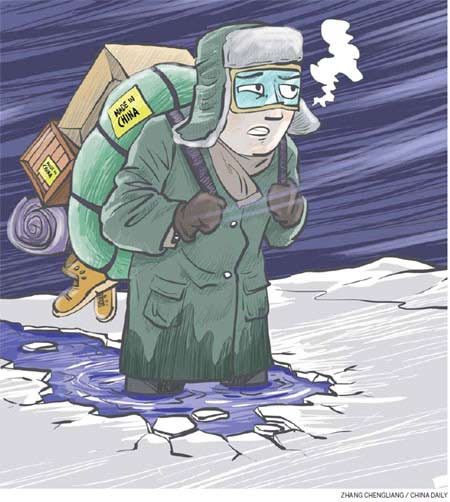
The temptation of delaying economic reform for the sake of so-called stability needs to be resisted
If ever you wanted proof that blessings can come in the guise of misfortune, then surely this is it.
Since China joined the World Trade Organization in late 2001, its trade has grown at more than 20 percent a year. That boom helped China to replace Germany as the world's largest exporter in 2009, and in all likelihood to become the world's largest trader by the end of this year.
But Chinese exporters and manufacturers have suffered two bouts of serious economic slowdown over the past 12 years.
The first coincided with the global financial crisis in 2008 and 2009, the world's worst financial meltdown since the Great Depression of the 1930s. China's exports experienced their largest setback as international orders drained away.
The drop in Chinese overseas shipments was not only sudden, but also deep and prolonged.
Exports fell 2.2 percent year-on-year in November 2008, after having risen 19.2 percent the previous month. The declines continued for more than a year, and growth returned in December 2009.
The wounds are still raw: Factories in the country's two major manufacturing powerhouses, the Pearl River Delta and the Yangtze River Delta, pulled down their shutters; migrant workers packed up and returned to their farmlands, and wage cuts became the order of the day.
For many Chinese exporters and workers it would have been a new experience: losing confidence, albeit briefly, in the country's economy.
But one result of these hefty export losses was that businesses began to realize that just as there can be economic sunshine, there can also be economic rain.
It was after the financial crisis that Chinese exporters and manufacturers, small ones in particular, learned to save for those rainy days through measures such as reserving part of their liquidity even when they are short of capital, carefully choosing foreign orders and employing more short-term workers.
Those measures are helping them deal with the export sluggishness triggered mostly by the European credit crisis and the US economic slowdown. The change of that mindset is remarkable, as can be gauged from my conversations with merchants in Yiwu, in Zhejiang province, over the past 10 years.
I have visited the city, known as the world's supermarket, three or four times a year since I became an analyst on the Chinese economy in 2001. I have talked extensively to business people there on each of my trips and made notes.
Between 2002 and 2007 merchants in Yiwu had a preoccupation with trade volumes and cheap prices, sometimes at risk of running out of liquidity.
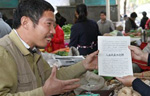
"What I care most about is increasing my orders by at least 20 percent more than last year," a lighters and trinkets trader told me in 2005. "If I cannot make it, I deem myself as a loser this year. That's the way we do business. You have to get enough orders to make a great profit. That's the No 1 rule for Yiwu. If you have a lot of orders you have nothing to fear."
That kind of thinking has largely disappeared, particularly since the 2008-09 financial crisis.
When I last went to Yiwu Small Commodity City, in September, people there were talking more about liquidity, relocation and, notably, product design.
In the past, Yiwu's merchants had a humdrum product line-up. Music boxes playing Jingle Bells were a Christmas staple. This year they are still prevalent, but look different.
Among those I saw last month was one with a theme based on Gangnam Style, a South Korean pop song accompanied by a video that has become popular worldwide thanks to the Internet. The most eye-catching part of the music box is a small statue of the singer who has made the song famous, wearing a Santa Claus hat, and in a horse-riding posture.
The vendor said he came up with the idea for the box with help from his young son, and it took a week for his factory to make it. Even though it cost 30 percent more than an ordinary music box, it sold particularly well.
"You have to offer something that is in and that is different from others," the vendor, in his 50s, said. That is exactly what analysts, including me, would call innovation.
Copyright 1995 - 2010 . All rights reserved. The content (including but not limited to text, photo, multimedia information, etc) published in this site belongs to China Daily Information Co (CDIC). Without written authorization from CDIC, such content shall not be republished or used in any form. Note: Browsers with 1024*768 or higher resolution are suggested for this site.
License for publishing multimedia online 0108263 Registration Number: 20100000002731