

 Comments
  Print
Print  Mail
Mail  Large Medium Small
Kingdom is natural hub as China approaches the Middle East and North Africa
If a global strategic realignment is taking shape and a new global order emerging, one element links Beijing and Riyadh. International relations have become more complex - "multi-polar" as some say - and emerging nations, particularly China and India in terms of size, and Saudi Arabia in terms of energy, are playing larger roles.

Constructive alignments are among the forces of stability, modernity and development - those who seek harmony and prosperity irrespective of political or ethnic differences. China and Saudi Arabia align in this constructive fashion.
Saudi Arabia is more than 10 times the size of Guangdong province, yet with about 28 million people, has less than one-third of Guangdong's population. The Kingdom of Saudi Arabia (its formal name) has no rivers or lakes, but what it does have is ample resources of energy - plus its position in the Islamic and regional world.
While China is Saudi Arabia's largest customer for oil and Saudi Arabia is China's largest supplier of oil - a trend that is expected to persist as growth continues to shift eastward - the foundation for a strategic Sino-Saudi trade and investment relationship grows broader and deeper. As China approaches the entire Middle East and North Africa region, particularly in agriculture and industry, Saudi Arabia, as the largest and most stable country in the region, is the natural hub.
With the largest GDP in the Arab world ($727 billion last year) - having more than tripled during the past 10 years - the kingdom is a member of the G20 and enjoys low inflation, a stable currency, low government debt and a large foreign reserve position. Saudi Arabia is the largest recipient of foreign direct investment in the Middle East and its policies and programs are designed to expand upon that advantage. The World Bank and the World Economic Forum give the kingdom high marks for economic reforms focused on improving the process of doing business.
Saudi Arabia's population is young and tech-savvy. With high Internet connectivity and extensive use of mobile devices, the kingdom offers both an excellent market and a promising talent pool.
Exemplifying the Saudi vision is the Global Competitiveness Forum, held each year in Riyadh. GCF is the Kingdom's most important economic/business event. This year it will feature a high-profile panel on Sino-Saudi business and investment opportunities (both directions).
In its seventh year, the GCF hosts local and regional authorities and business leaders interacting with world-renowned global thought leaders. For GCF 2014, to be held from Jan 18 to 20, the theme is "Building Competitive Partnerships" - in other words, investing in strategic alliances enables businesses to gain a competitive advantage through access to partners' resources, technologies, markets and capital - and this is especially true for Sino-Saudi commerce of all kinds.
The GCF is an annual meeting of global business leaders, political leaders and selected intellectuals and journalists brought together to create a dialogue on the positive impact organizational and national competitiveness can have on economic and social development, thus addressing how dimensions of competitiveness can foster economic growth and sustainable development.
Founded in 2006 by the Saudi Arabian General Investment Authority, the GCF tackles global issues in the context of each year's theme. GCF 2014 highlights "Building Competitive Partnerships" - how nations unleash their competitiveness potential with effective partnerships between private and public sectors, building alliances for driving innovation, nurturing entrepreneurship and cultivating employment, while striking the right balance between government regulations and fostering an attractive business environment that allows for private sector freedom and growth. All these issues are vital for China, especially in its new phase of reform and development announced this month.
Specific GCF issues include identifying pockets of local competitiveness; promoting model factories and SMEs to drive growth and new jobs; prioritizing sustainable investments for the future; shaping brand images and addressing customer perceptions; planning for "success beyond borders" in a globalized world.
At GCF 2014, SAGIA Governor Abdullatif Al-Othman will describe a new Saudi approach to investments, with incentive categories leveraging government expenditures to foster local content and expanding the energy value chain to include intensive manufacturing.
We believe that Sino-Saudi relations are a foundational building block of the new world order - which is confirmed by its resilience despite Middle East turbulence - and that Sino-Saudi business will become increasingly significant. The Saudi Ambassador to China, Yahya Al-Zaid, stressed: "There is a natural partnership between our two countries, a mutual interdependence that is founded on energy but is becoming broader and deeper."
Saudi officials call for "interdependence through cross-investments, open trade and cultural exchange" with China as "the cornerstones of stronger global cooperation in the realm of energy". The Saudis do not consider themselves as merely sellers of oil to China, but rather as strategic partners whose multifaceted relationships with China are founded on, as the CEO of Saudi Aramco, Khalid Al-Falih, put it, "mutual respect, mutual dependence and mutual benefit".
Reflecting the growing bonds between Saudi Arabia and China, the Saudi pavilion at Expo 2010 Shanghai was striking. It featured Arabic calligraphy, classic poetry and contemporary art. It housed the largest immersive motion picture screen in the world - introducing Saudi Arabia to the Chinese visitors. According to custom, when expos are over, all pavilions are dismantled. But the Saudi and China pavilions, each magnificent, remain, as if symbolizing a stable new alignment of the global order.
Robert Lawrence Kuhn is an international corporate strategist and investment banker. He is the author of How China's Leaders Think and the biography of former President Jiang Zemin. Florence Eid-Oakden is chief economist of Arabia Monitor, a research advisory firm focused on the Middle East & North Africa. Previously, she was chief economist for MENA at JPMorgan. She is on the boards of the Arab Banking Corp and AlFaisal University.
The views do not necessarily reflect those of China Daily.
 Largest span timber arch bridge
 Porsche 911 Turbo S Asian premiere fascinates Auto Guangzhou
 Auto Guangzhou witnesses new Porsche sports cars Asia Premiere
 2013 Guangzhou auto show carmakers' eventers
 Models at Volvo pavilion at 2013 Guangzhou auto show
 Lexus new hybrid hatch CT200h world premiere in Guangzhou
 New C-X17 showcases Jaguar's crossover concept
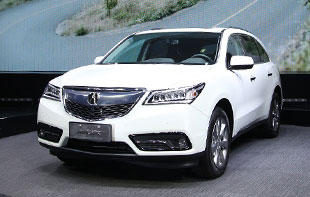 Acura all-new 2014 MDX comes to China
Copyright 1995 - . All rights reserved. The content (including but not limited to text, photo, multimedia information, etc) published in this site belongs to China Daily Information Co (CDIC). Without written authorization from CDIC, such content shall not be republished or used in any form. Note: Browsers with 1024*768 or higher resolution are suggested for this site.
License for publishing multimedia online Registration Number: 20100000002731