


 Comments
  Print
Print  Mail
Mail  Large Medium Small
The Ministry of Finance has begun drafting rules for local governments' debt regime, a task that is expected to be completed no late than the end of next year.
Having a system to match local government debt - which could increase by 30 trillion yuan ($4.9 trillion) from now to 2020 - with development needs is an indispensable part of the national program to speed urbanization, according to financial specialists close to the ministry.
Without regulations or standards for municipal-level debt financing, it will be hard for the market to play a role in allocating the resources needed by China's many fast-developing cities, they said.
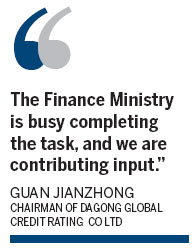
"The Finance Ministry is busy completing the task, and we are contributing input," said Guan Jianzhong, chairman of the Beijing-based Dagong Global Credit Rating Co Ltd.
"The system should be ready soon, probably no later than by the end of next year. Whatever the central government is determined to have, it can build rather quickly," Guan added.
A complete government debt regime would require local governments to not only issue debt independently but also to create balance sheets, file public financial reports and work with credit-rating services, Guan said.
But it would be risky to open the floodgates to local government fundraising activities before the regulatory framework is ready, he said.
Building the debt regime follows the reform hammered out by China's leaders at the recently completed Third Plenum of the 18th Central Committee of the Communist Party of China.
The plan allows local governments to broaden financing "through various ways" that include issuing bonds.
It also promises, without giving a timetable, to set up a "well-regulated system" for managing local government debt and warning of risks.
If they are all implemented, the changes represent a momentous shift from China's historic efforts to "contain" local government debt to "channeling" them in an orderly way, financial specialists said.
It basically acknowledges local governments' right to incur debt, although the nation's current budget laws still ban them from deficit financing and bond issuing.
To circumvent the ban, local governments often borrow heavily through so-called "local government financial vehicles". But such LGFVs, under the local governments' direct supervision, often are ill-managed and breed cronyism, experts say. With no rule requiring them to be financially transparent, the debts raised by these LGFVs have ballooned in recent years. Market estimates of the total debt vary between 15 trillion and 25 trillion yuan.
In July, the National Audit Office was ordered to conduct a nationwide audit of local government debt.
While the results have yet to be released, several senior officials said recently that the risk of local government debt is "under control", suggesting that the total debt falls within the central government's acceptable level.
But "auditing is not a solution," Guan said. "Although we know how much they've borrowed, that doesn't reflect whether they can repay their debts or not."
As a necessary step, the national government debt regime must include qualified credit rating agencies, he said. "They play a role that the audit office cannot replace."
A better solution, after the audit result is disclosed, is to have a debt management system in which results can be reported on a daily basis, experts said.
"China's urbanization drive will have a huge financing demand for construction of infrastructure, farmland and water conservancies, affordable housing, tourism development and so on. Under the current fiscal system, local revenue is far from enough," said Li Xiaopeng, a research fellow with the Urban China Initiative, a joint initiative led by Columbia University, the School of Public Policy and Management at Tsinghua University in Beijing and McKinsey & Co.
A recent study by UCI suggested that the central government should first acknowledge the legitimacy of local governments' liabilities and their rights to guarantee. Then local governments should report their debt audit results on a regular basis, and the central government should impose a ceiling for each province's total debt.
Consulting on the report were National Development and Reform Commission officials.
Copyright 1995 - . All rights reserved. The content (including but not limited to text, photo, multimedia information, etc) published in this site belongs to China Daily Information Co (CDIC). Without written authorization from CDIC, such content shall not be republished or used in any form. Note: Browsers with 1024*768 or higher resolution are suggested for this site.
License for publishing multimedia online Registration Number: 20100000002731