Rising demand in industrial and food industries has led to increasing imports of corn, wheat, soybeans
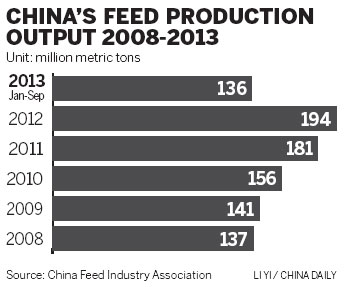
China's hunger for protein food has pushed the country to import more foreign grain, ensuring supplies for its booming animal feed processing industry to produce enough meat, eggs and milk to satisfy its growing population.
Led by the Chinese government's self-sufficiency policy for grain security, China's grain imports, including corn, wheat and soybeans, were limited before China loosened its restraints on foreign grain in 2001.
However, the stable growth of China's agricultural output and rising national incomes have provided diversified access to food with higher protein and better taste. Moreover, the country has raised the quantity of its grain imports, especially corn, wheat and soybeans, over the past decade to support the growth of the livestock feed industry.
More than 120 million metric tons of corn and 10.7 million tons of wheat were eaten by Chinese livestock in 2012, showing a 9.6 percent and 3.2 percent increase, respectively, from the previous year, according to the Beijing-based China Feed Industry Association.
To meet the growing demand, China purchased 5.12 million tons of wheat from the world market between January and November in 2013, a 39 percent rise from the same period a year earlier. The nation also imported 2.44 million tons of corn during the same period, a 6 percent increase on a year-on-year basis, according to the General Administration of Customs.
"More than 80 percent of imported corn is being used in the deep-processing industries of animal feed, ethyl alcohol and starch in China now. Industrial consumption now far exceeds food consumption demand," said Yu Bin, director of the Department of Macroeconomic Research at the State Council Development Research Center.
Food consumption is normally a clear indicator of the health of an economy and the size of its population. In China, meat consumption is rising, and people are eating a broader variety. Daily food such as meat, fish, eggs and milk has become more sophisticated, and people now look for more choices for healthy and convenient food.
"In terms of agricultural modernization, China is proceeding in an upward trajectory, especially in the meat production chain. Meat products using pork, chicken and beef are being produced increasingly using modern methods. Fewer animals are being fed in the backyard, and more are included in a modern feeding system," said Ding Lixin, a researcher at the Chinese Academy of Agricultural Sciences in Beijing.
The China Feed Industry Association said Chinese mills produced 136 million tons of feed in the first three quarters of 2013, down 8.7 percent on a year-on-year basis, mainly caused by a shortage of grain supplies in Zhejiang, Shandong and Jiangsu provinces, and a declining market demand for meat from the catering industry, which has been restricted by the national government's nationwide campaign to implement the "eight-point" rules to stop officials dining in restaurants using public funds.
Because pork is the staple meat for the Chinese, swine feed production reached 7.84 million tons between January and September of 2013, a 9.3 percent raise from the same period a year earlier.
Although the Ministry of Agriculture reported that China's grain output reached 601.94 million tons in 2013, a record high and the 10th consecutive year of increased grain harvests, Ding said the nation's demand growth should be taken into serious consideration under the changes in its agricultural sector, which is already struggling with limits on farmland acreage and water supplies.
China exported 8.74 million tons of animal feed to the world market in 2012, up 6 percent from the previous year. The feed was sold to a number of countries, including Mongolia, Ukraine, Australia and New Zealand, according to the Center of China Agriculture for Trade and Economy at the Ministry of Agriculture.
Under such circumstances, the China National Grain and Oils Information Center estimated China's grain demand will exceed 720 million tons by 2020. A gap between domestic supply and demand for major agricultural products is widening, which might cut the nation's meat production output in the future.
Wang Kai, a professor at Nanjing Agricultural University in Jiangsu province, said feed production is an indispensable link to connect many agricultural industries, such as the planting, livestock - including breeding - and fish farming sectors. Consequently, the government must ensure it can gain adequate supplies to prevent an inflation in prices of these grains caused by unpredicted shortages in preservation, speculation and unfavorable weather conditions.
"From the short-term perspective, importing corn, soybeans and wheat from the US, Brazil, Argentina and Ukraine is a practical way to stabilize the domestic price of grain and balance demand and supply," Wang said.
Copyright 1995 - . All rights reserved. The content (including but not limited to text, photo, multimedia information, etc) published in this site belongs to China Daily Information Co (CDIC). Without written authorization from CDIC, such content shall not be republished or used in any form. Note: Browsers with 1024*768 or higher resolution are suggested for this site.
License for publishing multimedia online 0108263 Registration Number: 20100000002731 

