Chinese officials have been expecting overseas direct investment to exceed foreign direct investment for several years. Given past trends and new government policies, the biggest question is not if it will happen, but when.
Over the years, many predictions have been made regarding when China would achieve parity between its ODI and FDI. In 2011, Zheng Chao, an official at the Ministry of Commerce, said ODI would exceed FDI within three years, predicting annual growth of 20 to 30 percent for ODI. In January, the commerce ministry spokesman Shen Danyang said ODI might exceed FDI in the coming year or two. Meanwhile, a study from the Economist Intelligence Unit predicted ODI would exceed FDI by 2017.
|
 |
|
 |
?
 |
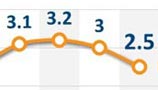
However, earlier growth rates suggest it will happen soon. The five-year compound annual growth rate for FDI was 4.9 percent, while that of ODI was 16.6 percent. If we assume that these growth rates continue in each of the next three years, ODI will exceed FDI in 2016, between Shen's prediction and the EIU's.
Of course, there are too many moving pieces to assume that growth rates will be exactly as they were in the past. Improving global economic conditions, for example, suggest that the growth rate of FDI is likely to improve this year, just as it did last year. FDI from the top 10 economies in Asia rose 7.1 percent year-on-year last year to $102.5 billion after falling 4.8 percent in 2012. A similar improvement from 2012 to 2013 was seen in the European Union (minus 3.8 percent in 2012 and 18.1 percent in 2013) and the United States (4.5 percent in 2012 and 7.1 percent in 2013).
More than any change in economic conditions, the biggest factor driving ODI and FDI in the coming years will be changes to government policy.
In support of ODI exceeding FDI sooner, easing outbound investment was explicitly mentioned in November at the Third Plenary Session of the 18th Communist Party of China Central Committee, a meeting of China's top Party officials that set the general tone for government policy for the coming decade.
Following this meeting, the Ministry of Commerce said in late January that it would remove a vast majority of approval items and only keep approval rights over investment in sensitive industries. Meanwhile, the National Development and Reform Commission said it would switch to a registration-based system for outbound investment of between $300 million and $1 billion and delegate approval decisions for investment under $300 million to its provincial branches. Both changes, if approved, would leave room for significant increases in ODI.
On the other hand, liberalization in the China (Shanghai) Pilot Free Trade Zone, which has been touted as one of the country's major reforms this year, could lead to a large increase in FDI. While the major focus of the media and commentators has been the financial reform aspect, the major steps taken in the zone to date have been liberalization of foreign ownership of assets and the removal of bans on foreign companies operating in restricted industries.
The author is head of the China office of London-based China economics research company NSBO.
|
 |
 |

Copyright 1995 - . All rights reserved. The content (including but not limited to text, photo, multimedia information, etc) published in this site belongs to China Daily Information Co (CDIC). Without written authorization from CDIC, such content shall not be republished or used in any form. Note: Browsers with 1024*768 or higher resolution are suggested for this site.
License for publishing multimedia online 0108263 Registration Number: 20100000002731