 |
|
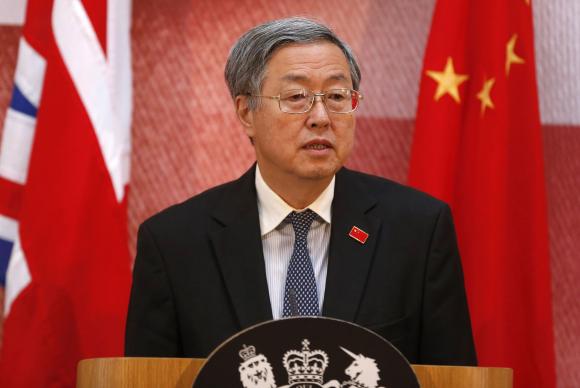
People's Bank of China Governor Zhou Xiaochuan addresses delegates at the UK-China Financial Forum at Lancaster House, in London June 18, 2014.?[Photo/Agencies] |
China will reduce its intervention in the foreign exchange market through a step-by-step process as it gradually pushes for foreign exchange reform, said central bank chief Zhou Xiaochuan.
"The direction is clear for China's foreign exchange market reform. We'll keep the yuan's exchange rate at a reasonable and balanced level and let the market decide the rate," Zhou said on the sidelines of the China-US Strategic and Economic Dialogue in Beijing on Thursday.
Zhou, who as governor of the People's Bank of China is in charge of the nation's monetary policy, said the central bank will still remain cautious and that it will intervene in the market if major fluctuations occur as major countries adjust their monetary policies.
US Treasury Secretary Jacob Lew said the US welcomes the market-oriented reform announced by China's leaders in November. The commitment by Zhou on Thursday will further China's implementation of its reform agenda, he added.
 |
Li Jianjun, a financial analyst at the Bank of China's International Finance Research Institute, said the Chinese government should understand that pressure for the yuan to appreciate may expand from a Sino-US bilateral problem to a multilateral one.
"Because of the US Federal Reserve's tapering of its quantitative easing policy, emerging markets are coming under increasing pressure from capital outflows. But the emerging markets also have a trade deficit with China, just as the US does. So the US may unite with those countries to push for the yuan to further rise," Li said.
The yuan has risen more than 30 percent against the US dollar since 2005 until it weakened in the first four months of this year. The yuan closed at 6.2035 to the dollar on Monday, down from 8.28 on July 21, 2005, the day that China announced a move to reform its exchange rate mechanism and revalued its currency.
The reform has played a vital role in narrowing China's trade surplus.
Over the past three years, the proportion of the current account surplus against the GDP dropped to a reasonable level that is internationally recognized, the nation's foreign-exchange regulator said.
The current account surplus fell from a record high of 10.1 percent of GDP in 2007 to 2 percent in 2013 and 0.3 percent in the first quarter of this year, said Du Peng, current account department chief of the State Administration of Foreign Exchange, at a news conference in Beijing on June 30.
Zheng Chaoyu, a professor of economics at Renmin University of China, said, "The US government used to say the yuan is undervalued, but that accusation does not hold water anymore.
"Even if the yuan continues to appreciate against the dollar over the long run, an appreciation still has to be done step by step in a controllable manner that can be expected."
China has been gradually promoting the marketization of exchange rates since 2005. This year, it accelerated the process.
On March 17, the People's Bank of China widened the daily trading band for the yuan against the US dollar from 1 percent to 2 percent.
A spokesperson for the PBOC said the adjustment is aimed at increasing the yuan's flexibility and that two-way fluctuation in the yuan will be the new norm. Investors should pay more attention to the medium and long-term trend of the yuan, the spokesperson said.
Li Jiabao contributed to this story.
 |
 |
|
|
|

Copyright 1995 - . All rights reserved. The content (including but not limited to text, photo, multimedia information, etc) published in this site belongs to China Daily Information Co (CDIC). Without written authorization from CDIC, such content shall not be republished or used in any form. Note: Browsers with 1024*768 or higher resolution are suggested for this site.
License for publishing multimedia online 0108263 Registration Number: 20100000002731