Locals can now enjoy modern comforts like hot water thanks to investment and tourism income
In July, I had the opportunity to visit the Tibet autonomous region at the invitation of officials from Beijing and the regional capital, Lhasa. The five-day trip left me cautiously optimistic about its future.
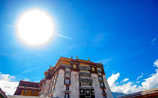
I did not see enough of its religious life to speak on the state of its temples and monks, but it was obvious that huge sums had been invested in improving the lives of Tibetans, especially those living in rural areas. In my five days there, I saw very few signs of the military or police, even in the city's allegedly more sensitive public areas, such as the Potala Palace and Barkhor Square, where the media had reported unrest in 2008.
Residents appeared content to simply go about their daily lives, and the mood was calm. I also noticed a lot of people from other parts of the country, a clear sign that tourism is flourishing and remains very much a pillar of the city's development strategy.
Jimy Wangtso, director-general of Lhasa's government information office and an ethnic Tibetan, told me that maintaining the old, undeveloped Tibet was unrealistic, and that improving the basic quality of life is a top priority. "You can't expect people to continue riding ox carts everywhere just because you, as a tourist, want to take photos of it," he said.
"Progress in people's livelihood is important. The West has progressed to a point where you don't have to worry about food and shelter as a basic necessity. For us, human rights mean the right to a better quality of life."
It was a cloudy morning when we visited the village of Apei, nine hours from Lhasa. With 149 residents, it sits like most settlements in Tibet at the foot of mountains facing a river that cuts through a lush, green valley. While officials directed our attention to residents dressed in traditional Tibetan outfits, welcoming us with their signature salted butter tea, I wandered the back streets.
What I remember most distinctly were the houses - some new, some old, but all built in the colorful look of a traditional Tibetan home. Regardless of shape, every one sported a solar water heater on its roof. Many had satellite dishes.
It was mid-July, but temperatures still barely reached 20 C, and at an altitude of 3,000 meters, I quickly realized how valuable hot water is here, something those living in developed nations like mine - Canada - take for granted.
According to official figures, Beijing has offered the equivalent of about $40 million in living allowances to help Tibet's most needy rural and urban residents. Officials say the region's per capita GDP has grown from about $25 in 1951 to just over $4,000 in 2012, and secondary industries like textiles and medicine production have grown into multibillion-dollar industries.
Evidence of major investment in modern infrastructure was everywhere. There are already two five-star hotels in Lhasa, and another is nearing completion - its distinctive white triangle designs jutting skyward reminiscent of the nearby snowy peaks.
The new complex is on the north bank of the Lhasa River, which is now linked to the city by a spanking new four-lane highway bridge.
It is 400 kilometers from the southeastern Nyingchi county to Lhasa, and expansion work on the highway that links the two will cut the drive time in half, to four hours. Lhasa's airport was upgraded a decade ago into a modern glass-and-steel structure, and it is now connected to the city center via a meticulously manicured 62-km expressway.
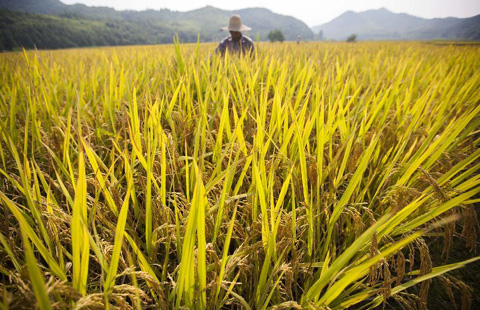
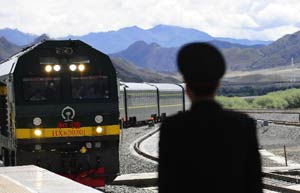
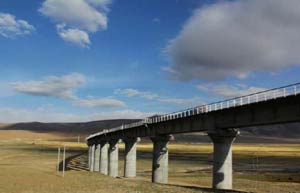
We visited factories producing traditional medicines and beer from local green barley - a treasured crop - that sported the most modern of European machinery. Beer poured off the lines at 36,000 bottles an hour, and can now reach markets quickly using the 1,956-km Qinghai-Tibet Railway.
 |
 |
|
|
|

Copyright 1995 - . All rights reserved. The content (including but not limited to text, photo, multimedia information, etc) published in this site belongs to China Daily Information Co (CDIC). Without written authorization from CDIC, such content shall not be republished or used in any form. Note: Browsers with 1024*768 or higher resolution are suggested for this site.
License for publishing multimedia online 0108263 Registration Number: 20100000002731