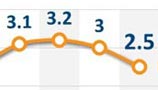
It sounds like a contradiction: China's development needs a cut in the 2015 GDP growth rate.
At least this way the economy would be easier to manage: When the government is less concerned about maintaining high growth, an inevitable result from continuous expansion in capital investment, it can spend more time and energy concentrating on more important things, first of all reform. Many of the reform efforts outlined by the famous Third Plenum in November 2013 are still to become reality.
Common sense in economics shows that the country is unlikely to sustain its present growth, an annual rate of 7.5 percent, without maintaining a considerable investment in fixed assets, especially expensive public projects led by the government.
For GDP growth to rise above 8 percent a year, it would generally take both the central and local governments to embark on many large projects at the same time. Judging from the local governments' record in contributing so much to industrial overcapacity and luxury housing, their enthusiasm for capital investment is the last thing needed by China at the moment.
As for other drivers of growth, economists say consumer-oriented industries, or the so-called service industries, don't yield so much growth as capital investment in the statistical sense (in GDP, for instance), even though they do create many jobs and make life easier and more colorful for consumers.
So the economic paper released in early October by economists from the Chinese Academy of Social Science, in which the forecast of China's GDP growth is lowered to 7 percent in 2015, is actually based on deep lessons. The CASS forecast is even lower than a recent IMF forecast of 7.1 percent.
It should be pointed out that the forecast figure from a Chinese think tank and that from an overseas body, although examining the same subject, are quite different things. An overseas forecast is a bystander's view, while a Chinese forecast sometimes implicitly contains a piece of policy advice, as the CASS forecast may do.
A lower growth target can only be a natural outcome of more effective reform. It means to concentrate the government commitment, and reduce the resources that interests outside reform, particularly what President Xi Jinping has recently called bureaucratic interest cliques, are allowed to share.
Indeed, no significant progress can be made in reform without China shedding more unwanted industrial capacity, closing down more building projects that serve no market demand, dampening interest in land speculation and housing prices in cities with no potential population growth, starving the luxury services aimed not at mass consumers but only bureaucratic consumption (such as officials' clubs and restaurants that once dotted many obscure corners in western Beijing), and stifling the shadow banking that used to grease the above goings-on.
These, as business activities, will have to be done away with. And the GDP loss they may represent won't be a negligible number, in jobs and in financial write-offs. Shutting down one steel mill can cost hundreds of jobs. And there are many running on paper-thin profit margins, with huge daily pollution discharges, still to be shut.
From China's 2014 experience, one can see clearly how hard, if not painful, it is for the government to keep GDP growth at the 7.5 percent level, and in the meantime, how many reform tasks remain unfinished, if not un-started.
Not many cities have been trying innovative ways to build their economies; many still rely on land auctions and, therefore, housing development accounts for most of their revenues.
In the State sector of the economy, not a single industry has reported successful progress in the mixed-ownership, or participation of private capital, that the Third Plenum promoted.
So, for 2015, Beijing's option may be very simple: To give up more speed, in return for more reform.
The author is editor-at-large of China Daily. Contact the writer at edzhang@chinadaily.com.cn
|
 |
 |
| Time for government to continue cracking whip for sustained progress | ?China embraced commodity economy in 1984 |

Copyright 1995 - . All rights reserved. The content (including but not limited to text, photo, multimedia information, etc) published in this site belongs to China Daily Information Co (CDIC). Without written authorization from CDIC, such content shall not be republished or used in any form. Note: Browsers with 1024*768 or higher resolution are suggested for this site.
License for publishing multimedia online 0108263 Registration Number: 20100000002731