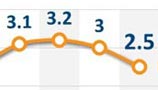
The National Bureau of Statistics has announced that the GDP growth rate for the third quarter is 7.3 percent. While the growth has reached the government's target, 'around 7.5 percent', there are still worries the drop is the future trend. These worries may be reasonable, since there is a big drop from last quarter's 7.5 percent to the current 7.3 percent. This is the lowest the growth rate has been since the first quarter of 2009.
However, the drop in growth rate is no surprise. It is noteworthy that the current Chinese economy is in a phase of triple impacts: growth model shift, structural adjustment and pre-stimulus digestion. Economic growth slowdown has been the trend for some time. The GDP growth rate was 11.7 percent in the period from 2003 to 2007. It declined to 9.0 percent from 2008 to 2013. The growth rate was only 7.7 percent for 2013.
Depending on the fast growth of exports, along with investment in urbanization and the rapid growth of employed population, there was a period of high speed growth after China joined the World Trade Organization. But after the subprime mortgage crisis, shrinking foreign demand along with marginal returns of government investment and a demographic shift have all forced China to transform its grow model.
For those who worry about further decline, it is hard to judge whether the growth rate will continue to decline because there are some uncertainties. For the fourth quarter of 2014, the growth rate may be no less than 7.3 percent, since the domestic and foreign consumption demand will generally be stable in the year end. Investment is also expected to remain stable. So for 2014, the growth rate is likely to end up at around 7.4 percent, which is just slightly lower than that of 2013. The rate is definitely not a small number, especially compared with most other countries.
Slowdown may be not good news, but when looking closely, one may find the drop in growth rate in GDP may be a good drop, since the small sacrifice in quantity brings better quality.
The main reason of the third quarter's drop lies in the decline in investment growth. The growth rate of investment for the first three quarters is 16.1 percent, which is 1.2 percent lower than the first half year. The decline in investment is mainly due to the rapid decline in investment of real estate, which declines 1.6 percent. There is in fact another reason which should not be ignored--the high base of last year's third quarter, which is 7.8 percent, the highest quater last year.
Since the traditional economic growth model depends too much on investment, especially investment on land and buildings, needs to be changed, one may conclude that the slowdown may be a good sign for a transformation.
There are other positive signs. From January to September, more than 10 million new urban jobs have been created, which is 100 thousand times more than last year. For the first half of the year, the energy consumption per unit of GDP fell by 4.2 percent and carbon emission intensity decreased by about 5 percent. Both are experiencing the biggest decline in many years. The disposable income per capita of urban residents grew 7 percent, which is also comparably better than last year.
The Consumer Price Index was at 1.96 percent for the third quarter, which is lower than last quarter's 2.20 percent and even lower compared to last year's 2.76 percent. The M2 supply increases were at 13.07 percent, lower than last quarter's 13.77 percent and last year's 14.47 percent.
China has long talked about converting its economic growth pattern, but one can hardly find any evidence to that effect. What we find is that excess currency has been issued, government investment has crowded out available investment chances from the private sector, government rent-seeking behavior has become more and more prevalent, the industrial structure has been difficult to get optimized, residents' income has increased slowly and the gap between rich and poor expanded to the extent that the society can hardly afford.
For the last three years, the growth rate of the economy represented by GDP growth rate has decreased; it seems that China has moved passed the transformation of economic growth and entered a new stage. A 'new norm' of economic growth appears that emphasizes quality rather than quantity.
Though the meaning of the 'new norm' of economic growth needs to be expanded, some features have been displayed. On the one hand, government will be more prudent in use of loose fiscal and monetary policy; on the other hand, consumption will be more important to economic growth. The difficulty in the transformation is the need to avoid a sudden economic downturn, since the old economic growth model is deeply entrenched and the new economic growth model needs time to grow.
The author is a lecturer at the Management School of the Shanghai University and a research fellow at the China Europe International Business School Lujiazui International Finance Research Center.
|
 |
 |
| Observers divided over China GDP | China's GDP in Q3 grows 7.3% |

Copyright 1995 - . All rights reserved. The content (including but not limited to text, photo, multimedia information, etc) published in this site belongs to China Daily Information Co (CDIC). Without written authorization from CDIC, such content shall not be republished or used in any form. Note: Browsers with 1024*768 or higher resolution are suggested for this site.
License for publishing multimedia online 0108263 Registration Number: 20100000002731