Chinese officials will start their annual Economic Work Conference on Dec 9, according to Takungpao.com in Hong Kong. The conference is a key part of China's economic decision-making process in the last weeks of every year, held to plan the coming year's targets.
The targets are not made public because they are still internal, waiting for approval by the National People's Congress in March, although it seldom changes any of them.
Other than the GDP growth rate, the Economic Work Conference will as a rule also propose the targets and strategies for inflation, money supply, fiscal revenue and expenditure, and imports and exports.
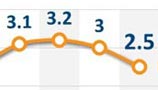
A few weeks ago, government think tanks began to float their "opinion" that China reduce its annual GDP growth target from this year's 7.5 percent to just 7 percent. If that is written into the Economic Work Conference strategy paper, China's growth would have officially entered the "from 7 percent down" range.
Ever since reforms began in the late 1970s, annualized 7 percent growth was one of the most difficult, if not entirely impossible, things to do in this country. The government wanted to grow fast for starters. Even if the central government wanted a temporary slowdown, local governments still wanted to grow fast.
So except for a chaotic few years between the 1980s and 1990s, China's economy had more time overheating and later bubbling than in a slowdown. And from time to time, the growth rate turned out to be higher than the target.
Local governments' enthusiasm was easy to understand, for officials' merits were measured by their report cards on economic growth. They were considered good officials just by continuing to build things, thereby generating favorable economic statistics.
It was a simple game. So simple that they did not have to bother to ask whether all the things that they wanted to build would be worthwhile. And they never had to bother to ask where the money would come from. Multinational corporations seeking cheap labor and the China market, land developers seeking new projects, and funds and projects from a more resource-rich central government never seemed to let down local officials who were promising whatever preferential terms their business friends wanted to hear.
Things are different now. The significance of the change is not just a figure. If it is only a difference of half a percentage point, as the growth target would be for 2015, so what? It is the big picture that is different. The old development players are all gone. Local governments, already deeply indebted, cannot make, let even less deliver on, as many promises to investors as they did before.
The country still does not have the right mix among its financial resources, its largest group of labor (most noticeably 7 million or so college graduates every year), its level of consumer demand (from the broad interests of millennials to the acute needs of the aging), and its legal and regulatory systems. There is a huge gap, in fact, in each case.
A harsh reality is that when the government doesn't know how to support needed development, and large corporations also aren't interested in doing it, many things will have to be created from scratch, through initiatives by individuals and small enterprises. Nor would the traditional financial system prove very helpful. But all that may be a good thing - because it would inevitably demand more government reform, especially cutting more red tape and making room for private business owners to play a bigger role in the economy.
That is why there are people who forecast that 2015 will be a more active year for private equity and venture capital businesses than ever. The A-share market may be having a rally since it is connected with the Hong Kong bourse, and the first interest cut in two years was made. But if the PE/VC forecast comes true, it would start a much bigger trend.
The author is editor-at-large of China Daily.

Copyright 1995 - . All rights reserved. The content (including but not limited to text, photo, multimedia information, etc) published in this site belongs to China Daily Information Co (CDIC). Without written authorization from CDIC, such content shall not be republished or used in any form. Note: Browsers with 1024*768 or higher resolution are suggested for this site.
License for publishing multimedia online 0108263 Registration Number: 130349