 |
|
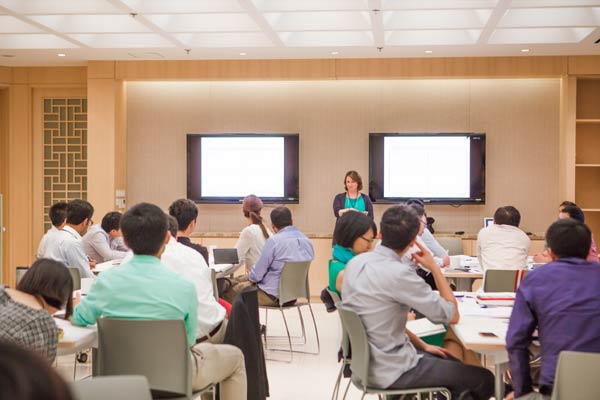
Students undergoing training sessions at the recent Stanford Ignite program on innovation and entrepreneurship at the Stanford Center of Peking University in Beijing.[Provided to China Daily] |
Wang Yi is one of 30 students in Beijing who enrolled in the recent Stanford Ignite certificate program, which teaches innovators how to formulate, develop, and commercialize their ideas.
Like many of his classmates who have launched a startup, Wang is the chief executive and cofounder of his own business, the app "Liu Li Shuo" (Chinese for "fluently speaking"), which helps Chinese practice spoken English on their mobile devices.
The Ignite program is designed to deliver the same kind of immersive, innovative, and hands-on instruction that working professionals and graduate students at Stanford University's Graduate School of Business experience.
It provides exposure to both the fundamentals of management and the practical aspects of identifying, evaluating, and moving business ideas forward and is aimed at participants with strong scientific, medical, or technical backgrounds who do not have an advanced degree in business.
In addition to offering short-term courses in Paris, France, Bengaluru in India and Santiago in Chile, where there are strong entrepreneurial communities, the university launched classes in Beijing.
Garth Saloner, dean of the Graduate School of Business, says: "There is a tremendous entrepreneurial spirit in China.
"There is a lot of energy that young people have for starting companies, and a lot of talented entrepreneurs have the potential to do amazing things."
Victor Koo, founder of internet television company Youku Tudou Inc, and Joe Chen, founder of "the Chinese Facebook" Renren.com, are both Stanford alumni who brought the core idea of entrepreneurship taught there back to China.
Wang took part in the courses that ran between September and November at the Stanford Center at Peking University.
As well as students from China, there were others from the United States, Canada, India, Saudi Arabia and Mongolia-all young working professionals with technical skills and leadership potential.
"The case studies and team projects helped crystalize vague concepts into integrated and specific business plans and I can now apply those ideas to my current work," Wang says.
Gao Peng, a researcher and developer for solar energy products, also enrolled in the course.
"Learning about entrepreneurship really helped me examine various aspects of my current role. The professors asked me many questions regarding the technology, production and marketing of our products, which spurred me to develop new ideas," Gao says.
Stanford provided the services of some its most-distinguished professors during the courses. Four faculty members flew to Beijing to be with the students while 10 others linked up via high-definition video conferencing, talking from either their own offices or empty classrooms back at Stanford in California.
The collaboration between Stanford and Peking University is still growing with both sides regularly conducting academic seminars through what they call "highly immersive classrooms"-two identical rooms in China and the US connected via a curved wall of video screens, giving the students in both locations the feeling they are in the same room.
The idea of providing elite business schools courses online is catching on quickly.
Wharton School at the University of Pennsylvania, for instance, has already put some of its first-year MBA core courses, such as financial accounting, marketing and corporate finance, online for free with teaching provided through pre-recorded lectures and online discussion boards.
In June, Harvard Business School launched a nine-week online course for undergraduates without a business background, which allows students to test whether they want to pursue a full-time MBA degree by learning the basics of business.
"Online education is a way of globalizing education," says Saloner.
"In the near future, the best content of all the schools is going to be increasingly available to all students around the world.
"For some subjects, students will be able to get access to really good content online instead of having to go to a particular school."

Copyright 1995 - . All rights reserved. The content (including but not limited to text, photo, multimedia information, etc) published in this site belongs to China Daily Information Co (CDIC). Without written authorization from CDIC, such content shall not be republished or used in any form. Note: Browsers with 1024*768 or higher resolution are suggested for this site.
License for publishing multimedia online 0108263 Registration Number: 130349