|
|
An elderly woman at a senior care home in Jinan, Shandong province, wears a bracelet that has her information in case she gets lost.[Provided to China Daily] |
Quick returns unlikely for investors despite huge market for services
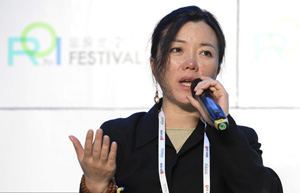
Chen Qi is wearing an elegant black qipao-a traditional Chinese dress-and her hair is tied back in a neat bun.
Behind her is a finely carved black wooden shelf holding vases and artwork from old Shanghai. To her right is a guzheng, a Chinese string musical instrument, and beside that an exquisite tea set that sits on an antique table.
Chen is not in an art gallery but in the relaxation center of the Red Sun Home for the aged in Hongkou district of Shanghai. As the head of the nursing home, she is showing visitors around. The group includes people who have come from overseas to see firsthand how China's senior care industry works.
"We decorated the room in a traditional style because many old people are keen on the traditional arts," says Chen, chairperson of Shanghai Red Sun Pension Investment Management. "We really want to let them maintain the lifestyle they are accustomed to."
In the West, aged care homes have long been an integral part of the suburban landscape, and their establishment and management have produced a well-developed industry. But senior care companies in China, local and foreign, have had a tough time trying to get their business models to take root.
Red Sun, regarded by many in the industry as one of the best senior care homes in Shanghai, welcomed 50 businesspeople the day Chen conducted her tour, while more than 100 business representatives were shown around homes in Hangzhou and Wuzhen, both in neighboring Zhejiang province, according to UBM, the organizer of the Care Show China, held in Shanghai in August.
A report on the industry published by China Research Center on Aging in September estimates that the domestic market for providing essential services and products for the aging population is worth 4 trillion yuan ($644 billion), or 8 percent of GDP, which is projected to climb to 33 percent of GDP by 2050.
By then, China will have become the largest market for businesses serving senior citizens.
China's seniors will account for a quarter of the world's total senior population, and their spending is expected to be worth 106 trillion yuan a year. The 202 million over-60s living in China last year accounted for 14.9 percent of the population. By 2050 the figure will have shot up to 480 million, the report says.
The possibilities that such figures offer investors in the future are also evident today. The country is grappling with problems in catering to the increasing aging population, chief among them a dearth of beds and services.
By the end of last year, there were about 42,500 organizations in China providing essential services and products for seniors, and 4.93 million beds for 200 million people, a person-to-bed ratio of 41:1.
But another set of figures, 4-2-1, is also giving policymakers a huge headache. These numbers represent the aging future that China faces largely as a result of family planning policies that have been in place for the past 30 years.
In keeping with strong filial obligations that are part of the Chinese family fabric, four grandparents and two parents in the great majority of cases in future will be the responsibility of just one child, and that poses huge challenges to the traditional way of aging at home.
So the State Council issued a policy paper a year ago on speeding up growth of the senior care industry by, among other things, encouraging businesses, governments and other sectors to play a role.
Since then local governments have set about taking measures to develop the industry.
Shanghai, for example, plans to invest 5 billion yuan to 8 billion yuan a year promoting the industry. A pilot program is being run in Minghang district, where a group of senior care communities will be built, and potential stakeholders are being invited to work with the government, each bed installed attracting subsidies of between 30,000 yuan and 50,000 yuan.
Rugao, a city in Jiangsu province, has more reasons than most to be preoccupied with aging and the challenges and benefits that come with it. With a quarter of its population over the age of 65, and 272 aged over 100, Rugao proudly wears the moniker of changshoushi, meaning "city of longevity".
The mayor of Rugao, Chen Xiaodong, led a team to the Care Show in Shanghai to meet potential investors. "We are keen to build a health industry in the city," he says. "Perhaps others can learn something from Rugao with its record of longevity. The city has a good natural environment, nice soil suitable for organic food, and a relaxing lifestyle."
The city plans to establish health industry chains taking in areas including biomedical instruments, organic and high efficiency agriculture, senior housing developments, and other products and services for seniors, he says.

Copyright 1995 - . All rights reserved. The content (including but not limited to text, photo, multimedia information, etc) published in this site belongs to China Daily Information Co (CDIC). Without written authorization from CDIC, such content shall not be republished or used in any form. Note: Browsers with 1024*768 or higher resolution are suggested for this site.
License for publishing multimedia online 0108263 Registration Number: 130349