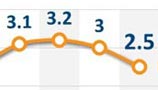
Like it or not, China's economic slowdown is beginning to bite, and it is in industry, manufacturing in particular, where the pain is being felt most.
Still, this is no bad thing if it helps the country phase out uncompetitive industries. But if the government were unable to come up with good policies to promote services to meet future demand, the economy would be stuck in its transition phase.
Nationwide, industry's weakness becomes clear when you look at year-on-year growth in the first quarter, just 6.4 percent, and compare that with growth in services, 7.9 percent.
Lian Ping, an economist with the Communication Bank of China, said that in terms of their respective contribution to GDP, services can claim a share of 56.5 percent, larger than their share any time in the past, while industry's share was a little more than 40 percent.
When you look at figures for provinces, the issue becomes even more stark.
Many cities have published figures for the first quarter, so it is easy to spot where a change has occurred, if indeed there is one.
Jiangsu province, on the east coast, which is one of the top three among Chinese provinces in GDP, with Guangdong and Shandong, usually publishes its economic figures more quickly and in a more standard way.
Jiangsu accounted for 6.5 trillion yuan ($1.1 trillion), or more than 10 percent of China's GDP of 63.65 trillion yuan last year.
In the GDP of 187.3 billion yuan for Nanjing, the provincial capital, in the first quarter, services accounted for 105.4 billion yuan and industry accounted for less than 77 billion yuan. The growth in services (10.2 percent) outstripped growth in industry (8 percent).
In Wuxi, arguably the most affluent city in the province-in per capita GDP, the gap between industry and services was even larger. In the first quarter, as industry rose 4.8 percent, services growth was double that, powered by, according to local media, the rapid growth in delivery/logistics services and a revival in real estate.
In the smaller and faster growing city of Yangzhou, services were reported to have grown 12.3 percent, compared with 9.1 percent for industry.
The Chinese media reported that throughout the Yangtze River Delta, where Jiangsu province is located, services have replaced industry as the main contributor to local GDP, as well as the main driver for overall economic growth.
In Shanghai, which occupies the largest port and container terminal for the Yangtze River Delta, services' share of local GDP (1.5 trillion yuan) was nearly 65 percent last year.
For the first quarter of the year, its GDP grew 6.6 percent, almost half a percentage point below the national average, with industry growing only 1.6 percent and services 9.8 percent.
So much growth in services in Shanghai is driven first and foremost by the robust business in the A-share market. In fact, its financial services alone grew 28.7 percent year-on-year, accounting for more than half the local economy's increment.
Don't forget, too, that the first quarter was slack for real estate, with many price controls that came into force four years ago remaining unchanged. Since then, housing market policies have gradually been liberalized, and that stands to add fuel to Shanghai's economy this year.
So, do the kinds of figures cited here really reflect a trend of services rapidly replacing industry, especially manufacturing, as the main driver of China's future growth? It is still hard to be sure about that.
It ought not be forgotten that the contribution of services to China's GDP is usually higher in the first quarter, mainly because of the Lunar New Year holiday shopping sprees and the huge amount of travel that is undertaken then.
In most other cities, industry has possibly been declining too rapidly, when its role as a growth driver cannot be entirely replaced by such low-tech services as home delivery and selling apartments.
How can local governments work with the private sector in developing all the future-oriented services toward a major improvement in the quality of life for all citizens? If the question is not duly answered, China's growth path would remain bumpy.
The author is editor-at-large of China Daily.

Copyright 1995 - . All rights reserved. The content (including but not limited to text, photo, multimedia information, etc) published in this site belongs to China Daily Information Co (CDIC). Without written authorization from CDIC, such content shall not be republished or used in any form. Note: Browsers with 1024*768 or higher resolution are suggested for this site.
License for publishing multimedia online 0108263 Registration Number: 130349