Officials are expected to take a four-pronged approach in the coming months to reduce growth risks.
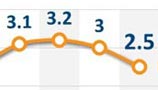
China's economic growth in the first quarter of 2015 was 7 percent year-on-year, the slowest since 2009, while investment grew only 2.8 percent, becoming the main drag on the economy. New jobs created in the first quarter added up to 3.24 million, 0.2 million less than the same period last year, and both the manufacturing and non-manufacturing purchasing managers indexes stayed below 50, suggesting reduced use of labor. The GDP deflator dropped into negative territory (-1.1 percent), implying the current growth rate is below potential. In other words, there is a negative output gap.
House sales slid 9 percent year-on-year and housing inventory rose 25 percent, while revenue from government land sales fell 36 percent. The sharp drop in land-sale revenue, along with tighter control of local government debt, will likely dampen infrastructure investment for the rest of the year. High-frequency data, such as new order indexes (as part of PMI), suggest the growth downturn has not run its course yet. And we forecast that GDP growth could fall further to 6.7 percent in the second quarter. We thus expect the government to take a four-pronged easing approach in the next few months to reduce growth risks.
First, the 2015 budget suggests a nearly 1 percentage point increase in the deficit/GDP ratio. This year's approved budget deficit is 2.3 percent of GDP, compared with 2.1 per cent in 2014. Our estimate suggests the budgeted deficit for this year will be 2.7 percent of GDP, which means the official budget leaves room for fiscal policy to be more proactive. But the extra-budgetary deficit is likely to decline due to stricter control of local government debt, and the more expansionary official budget will be offset by a tighter extra-budgetary stance. So the overall fiscal stance is likely to be neutral or slightly supportive.
Second, recent required reserve ratio cuts should boost M2 growth in the near term, but more is needed in the second half of the year. We forecast that China's trade surplus will exceed last year's level because of slower import growth, with other investment outflows in China's balance of payments to increase by 50 percent. So, even if the central bank injects liquidity on a net basis through open market operations and lending, it will still have to cut RRR by 100 basis points to raise the money multiplier in the second half and achieve a growth of about 12 percent for a couple of years, on the condition that capital outflows continue throughout the year.
Third, according to media reports, the central bank will convert its foreign exchange loans to China Development Bank ($32 billion) and Export-Import Bank of China ($30 billion) into equity stakes, and the Ministry of Finance will inject $25 billion as capital into the Agricultural Development Bank in the form of tax rebates. In the first two cases, the debt-for-equity deal should not increase net cash inflows, but the swap could significantly improve capital adequacy ratios, allowing the banks to take on more risk assets. Since the central bank has fixed the CAR for policy banks at 10.5 percent, the added capital will allow the three banks to take on additional risk assets of $700-800 billion, or 7-8 percent of 2014 GDP, over time. And the policy loans would provide much-needed financing for government-led initiatives, including the Belt and Road Initiative, the social housing program and agricultural modernization.
Fourth, the easing of property market policies both at the central and local levels suggests the government supports a rise in real housing demand (versus home-buying for investment and speculation) to help absorb excess supply. We think policy easing this year will aim at bolstering domestic demand, and the yuan will not depreciate. But we lower our 2015 GDP growth forecast to 6.9 percent (from 7.1 percent) because of the sluggish start to the year.
The author is head of Greater China Economic Research, Standard Chartered. The views do not necessarily reflect those of China Daily.

Copyright 1995 - . All rights reserved. The content (including but not limited to text, photo, multimedia information, etc) published in this site belongs to China Daily Information Co (CDIC). Without written authorization from CDIC, such content shall not be republished or used in any form. Note: Browsers with 1024*768 or higher resolution are suggested for this site.
License for publishing multimedia online 0108263 Registration Number: 130349