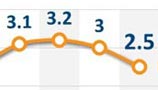
The Chinese economy is bottoming out with the employment rate rebounding significantly in the second quarter, according to a report by Southwestern University of Finance and Economics.
Employment is much improved, up from 61.1 percent to 70.6 percent, an increase of 9.5 percent compared with the first quarter.
Gan Li, director of the survey and research center for household finance at Southwestern University of Finance and Economics said: "The recovery in employment proves the economy has rebounded in the second quarter," adding that Chinese families are optimistic about the macro-economic trend in the next quarter.
China's economy posted 7 percent growth year on year in the second quarter, while GDP growth held steady at 7 percent in the first half, according to figures from the National Bureau of Statistics.
The report also showed the ratio of urban households purchasing property went up 2.3 percent in the second quarter, a slight increase compared with the first. The number of ubran families selling property is also on the rise.
The market in first-tier cities including Beijing, Shanghai, Guangzhou and Shenzhen is expected to rebound further in the second half, with prices continuing to grow.
The gap between family assets is also increasing as wealth accumulation is continuing in high-asset families, while the wealth of low-asset families is shrinking. Housing risk assets, such as stocks and funds, of high-asset families have appreciated while low-asset families are on the decline.
High-asset families mainly concentrate on first-tier cities, while low-asset families tend to be in second- and third-tier cities.
In contrast with the property market, the stock market will not surge dramatically in the second half and share holders may continue to reduce their stocks.
It is suggested that 3.7 percent of shareholding families bought property in the second quarter, up 1.4 percent compared with the first quarter, while only 2 percent non-shareholding families invested in real estate during the second quarter, a slight decrease on the first quarter.
The proportion of shareholding families which earned profits fell for the first time since the stock market collapse on June 15, and these families began to reduce their stocks gradually. Non-shareholding families are pessimistic about the stock market.
Gan said: "It shows the stock capital flow into the property market propels the property market to get warm again after a cold spell."
However, Gan pointed out that "The structure of family assets is not healthy because the property asset accounts for a large percentage, while the financial asset, such as stock and financial products, only takes up a small share."
The mobility of property assets is bad for it's difficult to convert bricks and mortar into money immediately. The financial assets that Chinese prefer to invest in mainly concentrate on stocks and bonds, which have a high risk, Gan said, adding that the asset risk of Chinese families is much higher than other developed countries.
Stock market participation in China is only 8.8 percent with the reason being the lack of financial knowledge. "The Chinese's knowledge about financial markets is like a junior school student, while those in developed countries are university students," Gan said.
fanfeifei@chinadaily.com.cn

Copyright 1995 - . All rights reserved. The content (including but not limited to text, photo, multimedia information, etc) published in this site belongs to China Daily Information Co (CDIC). Without written authorization from CDIC, such content shall not be republished or used in any form. Note: Browsers with 1024*768 or higher resolution are suggested for this site.
License for publishing multimedia online 0108263 Registration Number: 130349