 |
|
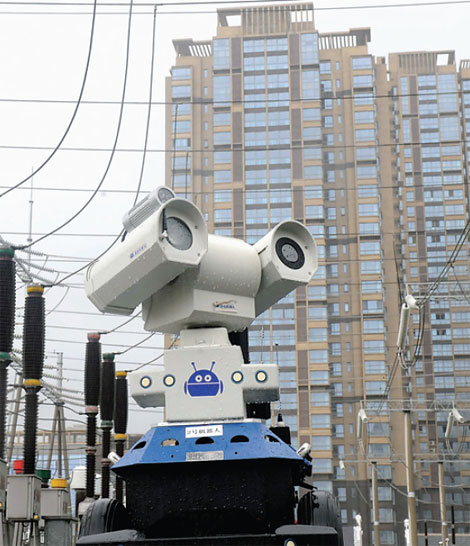
A robot monitors power-transmission equipment during a rainstorm in Chuzhou, Anhui, on Aug 10. [Photo/China Daily] |
"It's a fact that productivity and competitiveness are indispensable for a manufacturing enterprise to be successful in the global market. Robotics and automation are the solution," Litzenberger said.
The way ahead?
The pursuit of economic growth and high employment has been a top priority for governments around the world in the wake of the 2008 global economic crisis. As a result, many countries have turned to automation.
In 2011, US President Barack Obama included a National Robotics Initiative as part of the wider Advanced Manufacturing Initiative to boost US efforts in automation and robotics.
In 2012, the European Commission set out a plan for a "revolution" to re-industrialize Europe and boost economic growth, with the goal of increasing the contribution of industry to the EU's total GDP to 20 percent by 2020. Robotics and automation is a significant part of the plan.
In recent years, Japan, South Korea and China have all published plans for the development of robotics.
"Some people ask why developed countries need to develop robots when they barely have any strenuous manual work for the robots to do. The answer is that these countries and regions are trying to solve a different problem to China," said Song Xiaogang, executive director of the China Robot Industry Alliance.
"Smart manufacturing"-the use of advanced technologies, such as robotics and 3-D printers, in tandem with a highly skilled workforce-is the ultimate goal of the re-industrialization trend in these highly developed economies, Song said.
"The intention of smart manufacturing is to use automated technology to greatly shorten the R&D period, and thus increase the competitiveness of the companies," Song said.
Currently, complex testing and quality-control procedures mean that launching a product can be a prolonged process. However, if a computer can precisely simulate the testing and production processes, the development period could be shortened correspondingly.
"A precondition for computers to accurately simulate a real production scenario is that the entire production line must be fully automated, or completely controlled by the computer," Song said. "Developed countries such as the US, Japan and South Korea have accumulated enough data for smart manufacturing after spending many years developing the use of robotics, while China is a beginner at this stage."
Despite being a latecomer, China is not resigned to being a follower: a robotics industry guideline published by the Ministry of Industry and Information Technology in early 2014 spelled out two major objectives for the industry: meeting the huge market demand for low-end robots, and developing high-end robots.

Copyright 1995 - . All rights reserved. The content (including but not limited to text, photo, multimedia information, etc) published in this site belongs to China Daily Information Co (CDIC). Without written authorization from CDIC, such content shall not be republished or used in any form. Note: Browsers with 1024*768 or higher resolution are suggested for this site.
License for publishing multimedia online 0108263 Registration Number: 130349