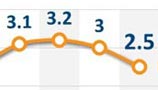
In first-tier cities, for every new home sold in October, there were nine unsold homes, and the ratio went up to 12.2 and 18.9 for second- and third-tier cities respectively, according to E-house China R&D Institute.
"The oversupply in real estate is a structural problem, with most inventories built up in lower-tier cities," said Huang Bin, an analyst with property research center CRIC.
To avert risks in those cities, developers tend to move their investment to bigger cities, resulting in the market divergence, Zhang explained.
In the first half of the year, more than 90 percent of funds spent by 20 major property developers on land purchase went to first- and second-tier cities, according to data from Centaline Property Agency.
An underlying factor behind the market movement has been the flow of migrant laborers to big cities, said Chen Jie, an economist at Shanghai University of Finance and Economics.
Despite the land fervor in metropolises, some have warned of industrial risks due to high inventories. Market competition in big cities like Beijing will become "brutal," according to a research note from Anbound Consulting.
To address the problem, authorities should adopt differentiated policies, said Meng Xiangyuan, a property researcher at Nanjing Forestry University.
He suggested "stabilizing developers' expectations" for land supply in top-tier cities to rein in the purchase rush, and curbing land supply in lower-tier cities to help digest house inventories.
Analysts have also called for faster reforms to the household registration system to accelerate urbanization and spur house purchases.
The future of China's property market has broader implications for the economy. Sagging property investment has dragged down China's GDP growth in the third quarter to a six-year low of 6.9 percent.
Wang Tao, a UBS economist, called a more prolonged property destocking process "the biggest downside risk" for China's growth.
The knock-on effect of a property construction downshift will continue to spread through the rest of the Chinese economy for the next two years, dampening demand for commodities and machinery, Wang said in a research note earlier this month.

Copyright 1995 - . All rights reserved. The content (including but not limited to text, photo, multimedia information, etc) published in this site belongs to China Daily Information Co (CDIC). Without written authorization from CDIC, such content shall not be republished or used in any form. Note: Browsers with 1024*768 or higher resolution are suggested for this site.
License for publishing multimedia online 0108263 Registration Number: 130349