BEIJING - With the stock market turmoil spooking global investors, a slowing economy looking for new sources of growth and looming uncertainties both at home and abroad, this year has been challenging for China's policy makers.
It won't be less challenging for the year ahead as the country continues managing the slowdown while proceeding with reforms and curbing growing risks.
In his latest comment about the economic performance this week, Premier Li Keqiang said the economy is moving within a reasonable range, and the country will maintain reforms to ensure steady economic growth.
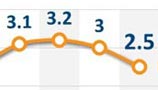
The economic growth is poised to post its weakest rate in a quarter of a century this year and widely expected to grind lower in 2016. Stabilizing growth will be high on the agenda for the upcoming Central Economic Work Conference, in which the government outlines the growth blueprint for the year ahead.
The economy grew 6.9 percent in the third quarter from a year earlier, the weakest pace since the global financial crisis, prompting the central bank to cut interest rates for six times in nearly a year.
Besides monetary easing, the government has been expanding fiscal spending to support infrastructure investment in an effort to put a floor under the slowing economy.
China has been pursuing reforms to steer toward a growth model based on stronger domestic demand, innovation and private sector instead of over-reliance on trade and credit expansion.
Reforms have targeted a wide range of issues, including a troubled property sector, non-performing loans at banks, corruption, pollution and overcapacity in many industries, as well as efforts to make its currency, the yuan, more accepted worldwide.
Some signs are emerging that the economic transformation is gradually taking hold. Consumption's share of the GDP is growing and the service sector is now bigger than the manufacturing sector as a percentage of GDP. Although consumption growth has slowed in the weakened economy, it has fallen much less than investment. Most important, innovation is booming.
However, as economic growth has slowed, there has been concern whether the resolve to pursue those reforms would fall by the wayside.
To soothe such concerns, Chinese leaders have repeatedly stated that the moderation in growth is a desired outcome of reforms. "I would otherwise be worried whether the reforms were working as intended," Li wrote in an article published in the Economist magazine.
Li called 2016 "a year of reform," saying "structural reform featuring entrepreneurship and innovation, greater openness and win-win international cooperation" will be priorities for 2016 and beyond.
Wang Tao, a UBS economist, said in 2016, the government is unlikely to deliver a massive stimulus package. Instead, "it will continue targeted support through fiscal and infrastructure measures, and accelerate structural reforms to unlock new sources of growth and support consumption"
Besides structural reform, the government will unveil reform policies to reduce excess capacity, enterprises' financing costs and a housing market oversupply as well as prevent financial sector risks, said Yang Weimin, vice minister of the Office of the Central Leading Group on Finance and Economic Affairs.
As China presses ahead with market-based reforms, enhancement of risk management becomes crucial as they bring both unprecedented opportunities and growing risks that demanded tougher safeguards, economists said.
Zhou Xiaochuan, the central bank governor, said minimizing financial risk will be a key challenge for China over the period covered by its new Five-year Plan and the success of financial reform hinges on stability in the sector.
Zhou called for a mechanism to be put in place to monitor and counter risks, and for better regulations against money laundering and terrorism financing.
It will be the "biggest success" of the next few years to evade any systematic risk and thus risk control should be attached equal importance as maintaining growth and advancing structural reform, said Liu Shijin, former deputy director of the State Council Development Research Center.
Nevertheless, China will stick to its opening-up in the financial arena, allowing foreign investments to enter more industries such as banking, securities and insurance, Zhou said.

Copyright 1995 - . All rights reserved. The content (including but not limited to text, photo, multimedia information, etc) published in this site belongs to China Daily Information Co (CDIC). Without written authorization from CDIC, such content shall not be republished or used in any form. Note: Browsers with 1024*768 or higher resolution are suggested for this site.
License for publishing multimedia online 0108263 Registration Number: 130349