 |
|
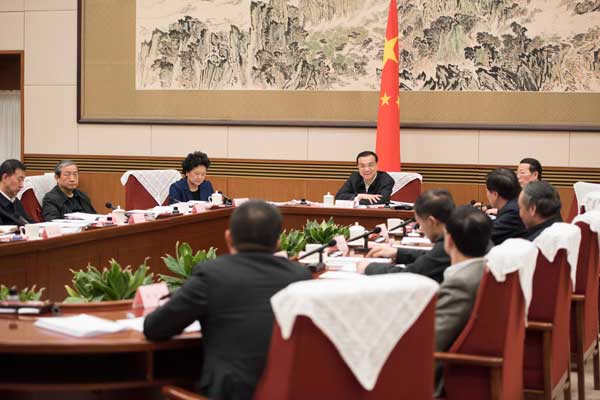
Chinese Premier Li Keqiang (C back) presides over a symposium to solicit opinions on the draft of the annual government work report and the country's 13th Five-Year Plan from leaders of non-Communist political parties, officials of the All-China Federation of Industry and Commerce and prominent figures without party affiliation in Beijing, capital of China, Jan. 25, 2016. [Photo/Xinhua] |
During the 13th Five-Year Plan period (2016-20), China's development will be powered by transformation and reforms.
While they can release the country's huge potential, China's economic transformation and upgrading will also face risks and challenges. Under these circumstances, China needs not only macroeconomic policy adjustments, but also key breakthroughs in its structural reform and supply-side reform.
During the 13th Five-Year Plan period, therefore, promoting adjustment to a services-dominated industrial structure is a key task, and the government will push forward marketized reforms and the opening-up of the service sector.
If the service sector increases to 60 percent of China's gross domestic product by 2020, that will not only create favorable conditions for reducing overcapacity, and destocking and deleveraging, it will also facilitate the sector's transformation and upgrading and release the huge demand potential.
Despite its great efforts to lower transaction costs for businesses through institutional reforms, which have formed a new driving force for its structural adjustments, the government still needs to make further efforts to open-up the services market to encourage and support the entry of private capital.
Despite the adoption of some policies to encourage the flow of private capital to the service sector, most of them lack operable details and workable methods, and administrative or market monopolistic practices still dominate. This calls for the making of a new market access system for the service sector.
To adapt to a new round of globalization and its own domestic economic transformation and upgrading, the country should break the existing restrictions and open-up the service sector inside its free trade areas, to create some replicable experiences. At the same time, it should apply policies to the service sector the same as it does to the industrial sector, such as narrowing the price gap between land for services and land for industrial use and increase tax cuts for small and medium-sized enterprises in the service sector.
The country should also optimize its distribution of State capital to lubricate its efforts to reduce the overcapacity in some industries.
To successfully promote structural adjustments during the 13th Five-Year Plan period, the key is to achieve a major breakthrough in the elimination of overcapacity among State-owned enterprises, and make these enterprises play an important role in adjusting the country's industrial structure. To this end, a clear reform program for the distribution of State capital should be worked out to promote the elimination, transformation, upgrading or merger of State capital in different fields with overcapacity.
The government should also accelerate reform of its decades-long hukou (household registration) system, and use a more equitable system to replace the existing dual urban-rural divide.
Urbanization will release new demand and create huge potential for new supplies. It still poses the "biggest dividend" for China's transformation-based development. But reform of the household registration system should not be based on simple name-changing, such as changing the "temporary residential permit" to a "residential permit", instead substantial steps must be made toward cancelling the dual hukou system. That demands the country make several changes in its household registration system, including shifting from population control between urban and rural areas to population services and management.
At the same time, the government should increase its efforts to simplify administrative procedures. The greatest potential for China's economic transformation and development lies in good handling of the relationship between the government and the market. The country has achieved tangible progress in releasing market potential and activating the vitality of enterprises though reforms in this area, but the delayed regulatory transformation presents the "biggest bottleneck" to delegating power from the government to the market.
To remove such obstacles, essential breakthroughs must be achieved in reform of the country's regulatory regime, such as pushing for separation of administrative approval and market regulation and setting up independent and authoritative specialized market regulatory bodies.
Industrial associations and the public should be given bigger supervisory roles as part of the efforts to promote the shift from traditional regulation to the market's self-governance.
The author is president of Haikou-based China Institute for Reform and Development.

Copyright 1995 - . All rights reserved. The content (including but not limited to text, photo, multimedia information, etc) published in this site belongs to China Daily Information Co (CDIC). Without written authorization from CDIC, such content shall not be republished or used in any form. Note: Browsers with 1024*768 or higher resolution are suggested for this site.
License for publishing multimedia online 0108263 Registration Number: 130349