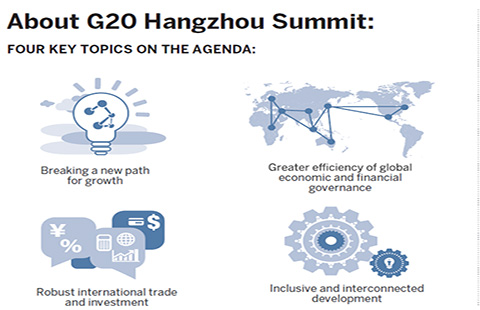
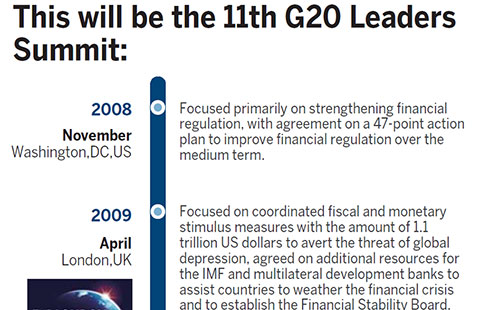
The G20 Leaders' Summit will be held in the Chinese city of Hangzhou on September 4 and 5, making it the first time that China hosts the meeting. China set the theme of the summit as "building an innovative, invigorated, interconnected and inclusive global economy," and the four agenda items are "breaking a new path for growth," "more effective and efficient global economic and financial governance," "robust international trade and investment," and "inclusive and interconnected development." The theme and agenda items demonstrate China's vision of improving the global economic governance and pushing the world economy back on track.
In order to improve the global economic governance, China has put forward a spate of proposals and initiatives since its current administration took office in 2012, including the Silk Road fund, the New Development Bank (formerly referred to as the BRICS Development Bank), the Asian Infrastructure Investment Bank and the "Belt and Road" initiative. Will the country come up with a new driving force for the world economy in the upcoming G20 summit?
China's role in the G20
As far as I can see, China seeks to achieve the following things in the summit. First, China seeks to improve global economic governance and become a major force for reforming global governance. Second, the country will promote its model and an international agenda. China seeks to share its experience of reform and opening up and economic development to boost its international presence and influence of public diplomacy. Third, China aims to rebuild the world order. As the world's largest developing country, China is dedicated to protecting the rights of developing countries in the current global governance system and urging developed countries to fulfill its obligations to developing countries.
There are three aspects to observe whether China fully delivers on its role of hosting the meeting. First, can China demonstrate its international coordination skills when confronted with the different agenda of developing countries, new industrial countries and developed countries? Second, can China fully play its leadership role during the coordination? Third, will China be able to provide global public goods to help the continuous development of developing countries and new industrial countries?
In order to revive the world economy, China needs to proactively promote the reform of global governance and the institutionalization of G20 governance.
China can institutionalize the following eight global governance issues, namely, economic and trade governance, financial governance, green governance (including environment and climate change), energy governance, conventional security issues, unconventional security issues (terrorism and epidemics), hot issues (e.g., the Brexit's impact on the world economy), and global cooperation programs (including dovetailing the strategies of various countries, for instance, China's "Belt and Road" initiative and South Korea's Eurasia Initiative).
Three institutions can be devised to facilitate the aforementioned issues. First, the G20 summit needs to be responsible for the top-level design of global economic governance. Second, a new minister meeting under the G20 should be launched to allow trade and foreign ministers of the participating countries to coordinate issues in the global economy. Third, a G20 secretariat should be established to handle the various issues of those countries.
Xi-Park meeting & China-ROK cooperation
China and South Korea established diplomatic relations in 1992, after years of secret negotiations due to the involvement of the interests of the island of Taiwan and North Korea.
Currently the two countries are facing economic downward pressure and the security of the Korean peninsula is under the sway of external interference (including the nuclear issue in North Korea, the influence of the United States and the deployment of the Terminal High Altitude Area Defense, shortly THAAD). China and South Korea should work closer to build a real strategic partnership.
Chinese President Xi Jinping and South Korean President Park Geun-hye should hold a meeting during the G20 to thaw the ice between the two countries in the wake of South Korea's decision in deploying THAAD. Moreover, the two countries should establish a long-standing negotiation mechanism.
The two countries can cooperate on the following fronts, if they indeed decide to resume cooperation during the G20. First, they should carry out more pragmatic cooperation on dovetailing the "Belt and Road" initiative and the Eurasia Initiative. Second, the two countries should carry out security talks behind closed doors in order to discuss their problems more candidly, including THAAD, the nuclear issue in North Korea, ROK-U.S. alliance, and China-DPRK alliance. Third, China and South Korea should expand public diplomacy on various fronts. Fourth, the two countries should cooperate on energy security. Fifth, the two countries should expand cultural exchanges among its people to better understand each other and explore the global market. Among the five, secret security talks and public diplomacy are the most important, which require a communicating mechanism between the two countries.
Only when China and South Korea proactively resume cooperation can the two countries pull themselves out of the current impasse brought by external force. The close cooperation between the two will decide their role in northeast Asia and help them become a force of peace in combating external interference.
Kim Sangsoon is a senior researcher at the Charhar Institute and the president of the Korea-based East Asia Peace Research Association.


Copyright 1995 - . All rights reserved. The content (including but not limited to text, photo, multimedia information, etc) published in this site belongs to China Daily Information Co (CDIC). Without written authorization from CDIC, such content shall not be republished or used in any form. Note: Browsers with 1024*768 or higher resolution are suggested for this site.
License for publishing multimedia online 0108263 Registration Number: 130349