|
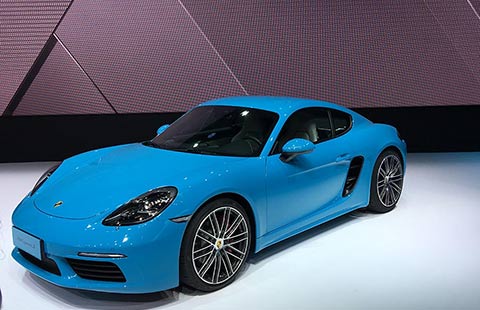
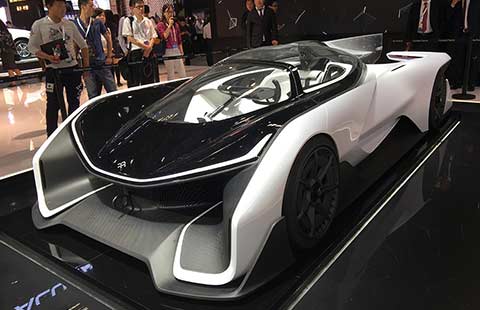
Visitors look at a new-energy vehicle at a recent auto exhibition in Nanjing, Jiangsu province. [Su Yang / For China Daily] |
Convergence digitalization and car sharing services expected to boost the sale of NEVs
The 2016 Beijing Auto Show, much like other recent shows held in Detroit, New York and Geneva, is expected to feature a range of sport utility vehicles and luxury models.
But for those with an interest in China's automotive industry, the auto show will be interesting for the domestically produced electric vehicles.
China's new energy vehicle market grew spectacularly in the last year. According to statistics from Gasgoo, an automotive intelligence survey covering the Chinese market, the number of NEV units sold last year reached 331,000, a 340 percent increase on the previous year.
China has now surpassed the United States as the largest NEV market globally, and the total cumulative number of NEV units sold in China exceeds the rest of the top eight countries combined. As well as the US, these are the Netherlands, Norway, the United Kingdom, France, Germany and Japan.

This is the result of heavy levels of support from the central and provincial governments, including subsidies and tax relief, as well as other policy initiatives such as a recent stipulation from the State Council that electric vehicles should make up half of all public institutions' annual vehicle purchases.
The government's attempts to spur the NEV market are aimed at achieving the twin objectives of developing a domestic car industry to compete with foreign manufacturers - beit in a certain segment of the market - d helping to mitigate some of the environmental problems associated with the country's rapid urbanization.
Two trends spur market
In spite of the industry's current reliance on State support, there are two related developments that suggest that NEVs will catch on. The first is the emergence of a cluster of carsharing start-ups in several major Chinese cities such as Shanghai, Beijing and Hangzhou.
Following on from the example of other successful car-sharing companies in a number of major Western cities including New York, London, Paris and Berlin, these companies are seeking to tap into the growing sharing economy.
Whereas previously customers opted for traditional vehicle ownership regardless of how frequently the car was used, more urban residents are demonstrating an increasing preference for mobility on demand due to the flexibility and reduced total cost of ownership.
Chinese consumers opting for car sharing often demonstrate a stronger preference for environmentally friendly vehicles including NEVS. As the number of car-sharing companies grows in China, this will have a knock-on effect on demand for NEVs.
Another trend that will be on display at the Beijing show is the growing convergence between the technology and automotive industries, a development often referred to as digitalization. Consumers have shown an increasing demand for digital products and services, which has prompted a number of technology companies such as Apple and Google to start making in-roads into the automotive industry. These companies are seeking to establish themselves as the main facilitators of the new customer-car interface.
KPMG's 2016 Global Automotive Executive Survey showed how disruptive this development could be. Over half of the executives canvassed cited connectivity and digitalization as the biggest industry disruptor over the next decade, surpassing growth from emerging markets, which was seen as the most important trend in the previous year's survey.
This is especially applicable to China as the country's industry is far younger and more flexible than mature markets. Over 90 percent of Chinese executives surveyed by KPMG said they expect disruption triggered by connectivity to affect automotive companies across all segments compared with a global average of 74 percent. Since most customers of car sharing services use smartphones to hire vehicles, this too is expected to have a knock-on effect on the sale of NEVs.
China's automotive industry is one of the fastest-growing globally and it is also one of the most rapidly changing. The convergence of two trends in the automotive industry - gitalization and car sharing services - expected to boost the sale of NEVs, which is a trend the Chinese government is actively encouraging.
In 2015, the government introduced subsidies of 31,500 yuan ($4,847) to 54,000 yuan per vehicle depending on the range of the car.
Although these are projected to fall to 28,800 yuan to 49,500 yuan by 2017 and then to 25,920 yuan to 44,550 yuan in 2019, according to Automotive Foresight, a Shanghai-based research firm covering the automotive industry, China's electric vehicle market should continue to grow provided battery costs continue to fall.
The lack of charging infrastructure and the need for improvements in battery range are the biggest barriers to mass adoption of electric cars.
But China's commitment to fostering the use of NEVs and the vast sums spent on research and development suggest that these obstacles will be overcome. For anyone interested in the future of not just the Chinese automotive industry but the global automotive industry, the Beijing auto show should be an interesting event to observe.
The author is head of Automotive Sector China, KPMG China.
(China Daily 04/25/2016 page36)

Copyright 1995 - . All rights reserved. The content (including but not limited to text, photo, multimedia information, etc) published in this site belongs to China Daily Information Co (CDIC). Without written authorization from CDIC, such content shall not be republished or used in any form. Note: Browsers with 1024*768 or higher resolution are suggested for this site.
License for publishing multimedia online 0108263 Registration Number: 20100000002731