|
|
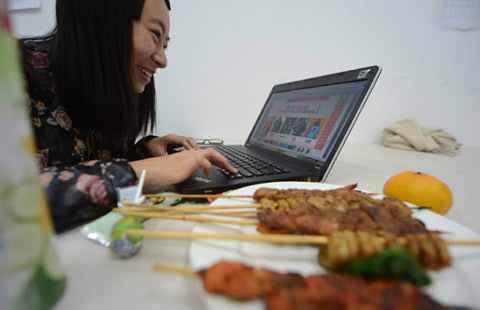
Sausage store owner Yu shows his business card with QR code image at a market in Hangzhou, East China's Zhejiang province, Jan 5, 2015. Customers welcome the method to pay via scanning the code with their smartphones because it is clean and quick. China's e-commerce leaders like Alibaba and Tencent have been promoting the new payment way in shopping or taking a taxi. [Photo/China News Service] |
Finance and payment
Online and offline businesses quickly converged in 2014, especially in the payment and finance sector.
What impressed Adam Xu, a partner with management consulting firm Strategy&, most in 2014 was the Dec 12 promotion by Alibaba.
Rather than luring people to buy goods online, the event got brick-and-mortar groceries and supermarkets to accept Alipay, an e-payment arm of Alibaba, as a payment method for products.
Alibaba's competitors such as Tencent Holdings Ltd and Baidu also launched mobile payment functions last year to allow people to pay online for services such as taxis, cinemas and restaurants.
More traditional sectors are expected to accept online payments this year. Xu said finance is the sector that was most transformed by Internet in 2014.
Whether it is online wealth management such as Yu'ebao or peer-to-peer financing, the innovation of technology has combined the convenience and high efficiency of the Internet with sophistication of finance.
"Technology enables new arbitrage between depositors and lenders. That will accelerate the liberalization of interest rates. We will see a booming funding channel for small and medium-sized enterprises where traditional banking cannot serve well. This will also trigger more changes among entrenched financial institutions," said Xu.
Shopping
Despite their small screens, mobile devices have demonstrated a strong power to attract online buyers.
According to technology consultancy Analysys International, the ranks of China's mobile-based online shoppers grew more than 35 percent to more than 300 million in 2014, compared with a growth of 25 percent in the number of PC-based shoppers.
During the Nov 11 Singles' Day sale event, Alibaba set a record in total transactions-and it also witnessed a record-breaking 42.6 percent of its transactions coming via mobile devices.
Apart from the increasing popularity of mobile apps of online platforms such as mobile Taobao, a significant number of vendors and e-commerce companies started to set up online businesses with the help of mobile social networking systems.
The teaming-up of JD.com, China's largest direct-sales online platform, and Tencent's WeChat was one such example.
Burghardt Groeber, an e-commerce expert and vice-president of greater China for enterprise software provider hybris AG, a division of Germany-based SAP AG, said in a recent e-commerce report that the value of China's mobile shopping market would top 1 trillion yuan by the end of 2017.
"Mobile e-commerce can help companies find more businesses in China's underdeveloped rural areas, where mobile penetration far outpaces fixed-line Internet penetration," he said.
Health and education
The mobile Internet market is dominated by Baidu, Alibaba and Tencent.
With its strong power in social networking, Tencent's apps such as WeChat and mobile QQ had 423 million users by the end of 2014, followed by Baidu's 218 million and Alibaba's 180 million.
"The apps owned or invested in by the three giants are already dominant players in the areas of social networking, tools and entertainment and consumption-related sectors," said Li Zhi, head of the research center at Analysys International.
"But it doesn't mean that newcomers have no opportunities. As long as you choose the right sector, you will become the next tech giant in China," she said, adding that education and health are the sectors that are expected to be changed most by the Internet in 2015.
Some Internet companies have made forays into these sectors, including Baidu and Alibaba, but there is no dominant player at this stage.

Copyright 1995 - . All rights reserved. The content (including but not limited to text, photo, multimedia information, etc) published in this site belongs to China Daily Information Co (CDIC). Without written authorization from CDIC, such content shall not be republished or used in any form. Note: Browsers with 1024*768 or higher resolution are suggested for this site.
License for publishing multimedia online 0108263 Registration Number: 130349