BEIJING - China's innovation drive has seen the emergence of three distinct regions in the country's developed east coast aspiring to become the next Silicon Valley.
The three regions are Haidian district in Beijing, which includes the country's tech hub Zhongguancun, Zhangjiang tech park in Shanghai and Nanshan district in southern Chinese boomtown Shenzhen.
Silicon Valley hopefuls
Some of China's earliest tech firms, including PC maker Lenovo, search engine Baidu and online portal Sina, can trace their roots back to Haidian in the 1990s. The district has been the breeding ground for the country's top Internet and tech firms ever since.
Official data shows that more than 33 tech start-ups sprung up in Haidian every day during Q1. The tech hub is also home to 22 companies that managed to become "unicorns," company with valuations exceeding $1 billion within five years.
Among these unicorns, Chinese ride-hailing firm Didi acquired its rival Uber China earlier this month and receives backing from top Chinese Internet giants Baidu, Alibaba and Tencent, as well as from Apple in the US.
Ksyun, a cloud computing subsidiary of Kingsoft, raised nearly $50 million in its latest funding round in May, making it the latest start-up in Zhongguancun with a valuation exceeding $1 billion.
"This region is producing top start-ups faster than anywhere else," said Wang Delu, President of Beijing Greatwall Enterprise Institute.
"Angel funds, venture capital, and government-back funds are all ready to fund the next unicorn start-ups in Haidian."
The district has over 1,500 funds specializing in equity financing.
"Many entrepreneurs I met here said they have been able to secure funding for their business faster than in other countries," said Mao Daqing, founder of start-up incubator UR Work.
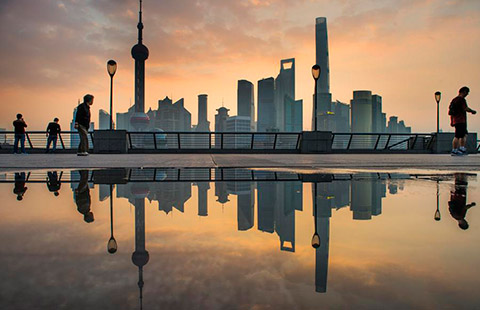
Zhangjiang, the high tech park east of downtown Shanghai, has long branded itself as China's silicon and medicine valley as it houses a number of chip manufacturers and drug makers.
The tech park is home to Semiconductor Manufacturing International Corporation (SMIC), the world's fourth largest chipmaker with $2.2 billion in 2015 revenue.
More than 300 drugs are being developed at the tech park. One in every three new drugs approved by China Food and Drug Administration comes from Zhangjiang.
The tech park also houses 133 research and development centers for multinational corporations.
"Innovation is carried out on a global scale and this is particularly true in Shanghai, where global and local talents work together. The city's vast array of world-class hospitals, research institutes and R&D centers constitute a complete industrial chain," said Du Ying, chairman of Zai Lab, a biotech firm based in Zhangjiang.
As China's smallest high-tech zone, Nanshan in Shenzhen covers only 11.5 square kilometers, or roughly 1 percent of Hong Kong, but is home to more than 7,000 companies, including 84 listed firms.
DJI, a drone maker based in Nanshan, has pioneered the development of drones for consumers. Currently, DJI products have gained 70 percent of the consumer drone market across the world.
In addition to DJI, Nanshan also boasts telecom giants Huawei, ZTE and Internet giant Tencent, all of which are world leaders in their respective fields.
The tech hub's proximity to the country's IT manufacturing base has also allowed companies to turn cutting edge technologies into affordable consumer electronics.
Nanshan's Appotronics has managed to use its laser display technology to produce 100-inch televisions at 10,000 yuan, making it the first company in the world to have applied laser displays in mass production.
Still cathin up
The three regions do, however, have their shortcomings.Shenzhen's lack of top universities and research institutes calls into question the sustainability of innovation in Nanshan.
Huawei's CEO Ren Zhengfei said at a national conference on technological innovation earlier this year that the company had waded into uncharted waters in technology and lacked guidance. The reason for that, Ren said, is insufficient scientific research.
To address this problem, Shenzhen has asked world-leading universities to build campuses in the city and plans to have 20 higher learning institutes in the next 10 years.
At Zhangjiang, medical research is led by foreign drugmakers. Even in co-development projects, the Chinese side still have difficulty in obtaining critical technologies.
Despite being a hub for innovative internet start-ups, Haidian still has a long way to go to match Silicon valley in terms of innovation.
"Companies here in Haidian are still modelling after their predecessors in Silicon Valley," said Cheng Fang, president of Tsinghua Technology & Innovation Holdings.
"Silicon Valley has produced the world's leading suite of tech giants such as Apple, Google, Cisco and Oracle. Companies from Haidian still do not quite measure up."


Copyright 1995 - . All rights reserved. The content (including but not limited to text, photo, multimedia information, etc) published in this site belongs to China Daily Information Co (CDIC). Without written authorization from CDIC, such content shall not be republished or used in any form. Note: Browsers with 1024*768 or higher resolution are suggested for this site.
License for publishing multimedia online 0108263 Registration Number: 130349