Walk into any Japanese noodle shop or restaurant and chances are you'll be
eating with a pair of disposable wooden chopsticks from China. But not for long.
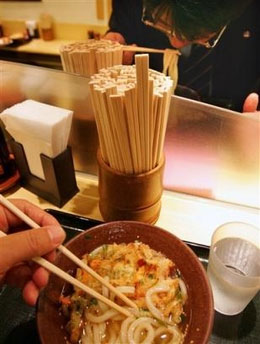
People eat noodle using
chopsticks called 'waribashi' at a fast-food chain restaurant in Tokyo
Tuesday, May 10, 2006. [AP] |
In a move that has cheered environmentalists but worried restaurant owners,
China has slapped a 5 percent tax on the chopsticks over concerns of
deforestation.
The move is hitting hard at the Japanese, who consume a tremendous 25 billion
sets of wooden chopsticks a year ¡ª about 200 pairs per person. Some 97 percent
of them come from China.
Chinese chopstick exporters have responded to the tax increase and a rise in
other costs by slapping a 30 percent hike on chopstick prices ¡ª with a planned
additional 20 percent increase pending.
The price hike has sent Japanese restaurants scrambling to find alternative
sources for chopsticks, called "waribashi" in Japanese.
"We're not in an emergency situation yet, but there has been some impact,"
said Ichiro Fukuoka, director of Japan Chopsticks Import Association.
A pair of waribashi that used to cost a little over 1 yen ¡ª less than 1 cent
¡ª now goes for 1.5 to 1.7 yen. The rising costs of raw wood and transportation
because of higher oil prices have also contributed to the rise, industry
officials said.
But pretty soon, some fear Japan won't even be able to get expensive
chopsticks from China: Japanese newspapers Mainichi and Nihon Keizai reported
that China is expected to stop waribashi exports to Japan as early as 2008.
To minimize the impact, Japanese importers now buy more bamboo chopsticks and
are considering new suppliers, including Vietnam, Indonesia and Russia, said
Fukuoka.
Convenience store operators are trying to cushion the impact through
cost-cutting in distribution.
"We provide chopsticks only to customers who ask for them," said Mayumi Ito,
a spokeswoman for Seven & I Holdings Co., owner of 7-Eleven convenience
stores. "We're closely watching the development."
Until the 1980s, about half the disposable chopsticks used in Japan were
produced by Japanese companies. But that changed with the introduction of far
cheaper Chinese-produced ones.
Supporters of environmental causes see the new Chinese tax as a chance to get
rid of disposable chopsticks, which have been linked to deforestation and a
wasteful lifestyle.
An Osaka-based restaurant chain operator, Marche Corp., switched to reusable
plastic chopsticks in February at its 760 outlets after testing various
materials over six months, said company spokesman Michihiro Ajioka.
The chain still keeps waribashi in stock in case customers have trouble
snaring noodles with plastic chopsticks, he said. Customers who bring their own
chopsticks also get a small discount.
A pair of plastic chopsticks costs about $1.17 and can be reused some 130
times ¡ª a cost-per-use that matches a pair of waribashi, Ajioka said.
"So far, we haven't received any complaints," he said. "The amount of garbage
has decreased significantly, which is definitely better for the environment."
Japan is China's largest export destination, while China is the third-largest
market for Japanese goods, according to government figures.
Japan's trade with China rose 12.7 percent in 2005 to $189.4 billion in its
seventh straight year of growth, according to the Japan External Trade
Organization.
However, ties between the two countries have become increasingly strained
amid a dispute over the ownership of undersea gas fields claimed by both.
Other territorial tiffs and Prime Minister Junichiro Koizumi's repeated
visits to a Tokyo war shrine that Beijing considers a glorification of
militarism have also put a strain on ties. The shrine honors Japan's 2.5 million
war dead, including several executed World War II war criminals. China has
strongly protested the visits and boycotted summits with Koizumi until he
pledges to stop going.
