|
Scientists seek way to protect wooden pagoda
(Xinhua)
Updated: 2006-09-03 15:35
YINGXIAN, Shanxi -- Chinese scientists have been seeking ways to prolong the
life of a 950-year-old wooden pagoda in northern Shanxi Province by another
millennium, but they are still baffled over how to do it.
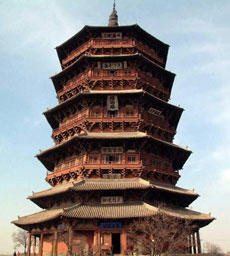
The Sakyamuni Pagoda in Yingxian County,
Shanxi Province. [file] | The Sakyamuni Pagoda
with unique architectural, religious and historical values is located at the
Fogong (Buddha's Palace) Temple in Shanxi's Yingxian County, 380 km southwest of
Beijing. It was built in 1056 during the Liao Dynasty, which ruled North China
from 916 to 1125. China will celebrate the 950th anniversary of the pagoda on
September 5.
The Sakyamuni Pagoda was made entirely of wooden parts
joined by innumerable mortises and tenons in a complicated structure of
brackets, without using any nails. It measures 67.31 meters in height and 30.27
meters in diameter at the base, or the height of a 20-story building today.
It is an octagonal structure of nine stories, with five visible from
outside and four hidden inside. The Buddhist statues in each story and paintings
on the inner walls of the first story are all works of the Liao Dynasty.
During a renovation of the pagoda in 1974, a number of sutras were
found, some hand-written and others block printed. They are important materials
for the study of religion and printing technology of the Liao Dynasty, as well
as the political, economic and cultural developments of the dynasty.
The
pagoda has undergone numerous tests in the centuries, including earthquakes,
storms, lightening strikes and wars, and remained intact.
But experts
warned the pagoda might succumb to another violent quake or storm, as the tower
is tilting.
There have been an obvious tilt between the first and second
floors and cracks in the interior wooden columns, said Chai Zejun, former
director of the Shanxi Provincial Ancient Architecture Institute.
There
are also 300 places in the pagoda that need repair, he said. "We are worried
about the ancient pagoda's safety."
As a matter of fact, China started
mulling over fixing the pagoda 17 years ago, when senior official Li Ruihuan saw
the damaged condition of the pagoda and called for better protection of it. A
group of renowned experts on ancient architecture, including Chai and Luo Zhewen
of the State Administration of Cultural Heritage, have been conducting
investigation, research and discussions on how to fix it.
But years of
efforts have not turned out a solution, as all the proposed plans have pros and
cons and each plan met with objections.
Experts have proposed three
options: dismantle it and rebuild it with the original timber parts and
technology; elevate the top three stories to fix the two bottom stories and then
place the top three back to position; reinforce the damaged and twisted parts
with steel structures, said Fu Xi'nian, a research fellow with the Institute of
Architectural History under the Beijing-based China Architecture Design and
Research Group.
"The first option will give us a new pagoda built by
ourselves instead of our ancestors 950 years ago, and its historical information
and value will get lost; the second one will turn out a pagoda with two new
bottom stories, and what is more, can we place the top three stories exactly
back to the original position? In the third option, the bottom two stories will
not be as spacious and bright as today when steel structures are installed
inside," he said.
"Experts haven't reached consensus, and I myself
firmly oppose the first option," said Fu, who is an academician of the Chinese
Academy of Engineering.
But 82-year-old Luo Zhewen, who has visited the
pagoda dozens of times since 1952, is a strong supporter of the first plan.
"The most simple way is to dismantle it for rebuilding, which has been a
common practice for thousands of years," he said.
Ma Bingjian, director
of the Beijing Municipal Institute of Ancient Architecture Design, another
advocate of the first plan, said, "To keep the pagoda is to keep the primary
historical information."
In fact, the second option won the approval of
the State Administration of Cultural Heritage in December 2002 when it organized
a group of experts to decide on the three plans by voting, because this option
was believed to cause less "disturbances"to the pagoda and be able to "preserve
more historical information," according to Ma.
After that, the
administration assigned the task of preparing an engineering plan respectively
to Taiyuan University of Technology in Shanxi and Southeast University in east
China's Jiangsu Province.
But both plans by the two universities were
turned down by an experts panel who met in April this year in Shuozhou City,
which administers Yingxian County.
Both plans called for huge steel
structures -- Southeast University's needs 1,300 tons and Taiyuan University of
Technology's needs 4,000 tons -- to be set up around the pagoda, which will
inevitably cause "severe disturbances" to the pagoda and produce "unpredictable
consequences," Ma said.
In addition, the plans would take as much as 90
million yuan (US$11.25 million), and about six to 10 years to repair the pagoda,
he said. "That is really terrifying."
The repair project seemed to come
to a dead end, but Zhou Ganzhi, former vice minister of construction,didn't
think so.
"As far as I know, the research has not stopped, neither has
the work of reinforcement and protection of the pagoda," said Zhou, also an
academician of the Chinese Academy of Sciences and the Chinese Academy of
Engineering.
"The proposed plans are not absolutely independent of each
other, and some parts of them may be combined," he
said.
|
| |
|
| |
|
|
|
| Most Commented/Read Stories in 48 Hours |
|
|
|
|
