 |
|
|
||||||||||||
|
China's National Defense in 2006
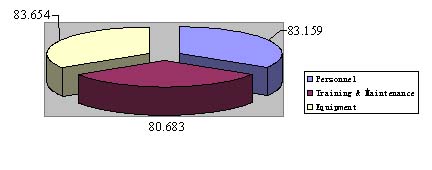
IX. Defense Expenditure Pursuant to the National Defense Law and the Budget Law, and guided by the principle of coordinated development of national defense and the economy, the Chinese government decides on the size and use of defense expenditure in an appropriate way to meet the demands of national defense in keeping with China's economic development. China's defense expenditure mainly comprises expenses for personnel, training and maintenance, and equipment. Personnel expenses mainly cover salaries, insurance, food, clothing, and welfare benefits for officers, non-commissioned officers and enlisted men as well as for civilian employees. Training and maintenance expenses cover troop training, institutional education, construction and maintenance of installations and facilities, and other expenses on routine consumables. The equipment expenses mainly cover research on, experimentation with, and procurement, maintenance, transportation and storage of weaponry and equipment. The defense expenditure covers not only the active forces, but also the militia and reserve forces. Also covered by the defense expenditure are costs to support part of the retired officers, education of servicemen's children and the national economic development, as well as other social expenses. Since the early 1990s, to safeguard its sovereignty, security and unity, and to keep pace with the global revolution in military affairs, China has gradually increased its defense expenditure on the basis of its economic development. This increase, however, is compensatory in nature, and is designed to enhance the originally weak defense foundation. It is a moderate increase in step with China's national economic development. In the 1980s, China began to shift the focus of its work to economic development. At that time, it was decided that national defense should be both subordinated to and serve the country's overall economic development. As a result, national defense received a low input, and was in a state of self-preservation. From 1979 to 1989, the average annual increase of defense expenditure was 1.23 percent. However, the defense expenditure actually registered an average annual decrease of 5.83 percent, given the 7.49 percent average annual increase of the consumer price index in the same period. From 1990 to 2005, the average annual increase in defense expenditure was 15.36 percent. As the average annual increase of the consumer price index during the same period was 5.22 percent, the actual average increase in defense expenditure was 9.64 percent. Chart 1: Comparison Between the Growth Rate of China's Defense Expenditure
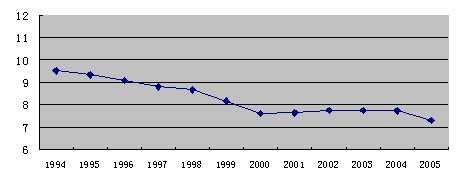
and the National Residential Consumer Price Index (1989-2005) China's GDP in 2004 and 2005 was RMB15,987.8 billion and RMB18,308.5 billion, respectively, with a growth rate of 10.1 percent in 2004 and of 10.2 percent in 2005. The state financial expenditure was RMB2,848.689 billion in 2004 and RMB3,393.028 billion in 2005, up 15.57 percent and 19.11 percent respectively over the previous year. China's defense expenditure in 2004 and 2005 was RMB220.001 billion and RMB247.496 billion, respectively, with growth rates of 15.31 percent and 12.50 percent. In the past two years, the share of China's annual defense expenditure in its GDP and in the state financial expenditure in the same period has decreased, being 1.40 percent and 7.74 percent respectively in 2003, 1.38 percent and 7.72 percent in 2004, and 1.35 percent and 7.29 percent in 2005. Its defense budget for 2006 is RMB283.829 billion. Chart 2: Share of China's Annual Defense Expenditure in the State Financial Expenditure (1994-2005) (%)
Chart 3: Composition of China's Defense Expenditure in 2005 (unit: RMB billion)
|
|