CHINA> News

|
CHINA> News
|
|
Xinjiang targets drug trafficking
By Lei Xiaoxun and Zhu Zhe (China Daily)
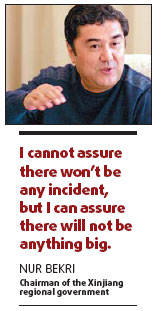
Updated: 2009-03-10 07:42 The Xinjiang Uygur autonomous region plans to beef up the border police force to deal with rising drug trafficking from the neighboring "Golden Crescent" region, a top local official has said. "We have asked (the central government) for the deployment of more security forces along the border. The current number is simply not enough," Nur Bekri, chairman of the regional government, told China Daily on the sidelines of the annual session of the National People's Congress, the top legislature.
Bekri said the rising incidence of drug trafficking from the "Golden Crescent" region requires more border police. The "Golden Crescent", which encompasses the mountain valleys of Iran, Afghanistan and Pakistan, has become the world's primary drug source. Local police cracked 1,563 drug-related cases last year, arresting nearly 2,000 suspects and seizing 144 kg of heroin and 6.72 kg of "ice", with drugs coming from the "Golden Crescent" accounting for 50 percent of the cases, according to latest police figures. In Urumqi, 70 percent of the drugs come from the "Golden Crescent". Bekri said the drug problem has become serious in Xinjiang. "While traffickers are trying to make Xinjiang a transit point, consumption within the region is increasing as well," he said. Increased drug use has resulted in rising HIV infections in the region, with needle sharing accounting for nearly two-thirds of the cases. Figures from the Chinese Center for Disease Control and Prevention show that by September 2008, Xinjiang had reported 24,818 HIV-infection cases, ranking fourth among all provinces, municipalities and autonomous regions in the country. The infection ratio is the highest in the country, according to the center, as Xinjiang has only 20 million residents. Bekri said the regional government plans to allocate 40 million yuan ($5.85 million) this year for the prevention of HIV/AIDS. The money, to be increased annually, will be mainly used for education programs and de-addiction treatment. Bekri also said that this year's security situation in Xinjiang is "more severe" compared with previous years. This year marks the region's 60th anniversary of peaceful liberation. It is home to more than 10.96 million ethnic minority people such as Uygurs, Mongolians and the Hui; and is in the frontline in the battle against the "three evil forces" of separatists, terrorists and extremists. Bekri said this year is a time of celebration for Xinjiang people but hostile forces will not give up an opportunity to destroy it. The situation in South Asia, including terror attacks in India, Afghanistan and Pakistan, are also a spur to the three forces, he said. "The 'three forces' will never give up their actions, but they can never prevail," he said. "I cannot assure there won't be any incident, but I can assure there will not be anything big." He said the current number of border security staff remains the same as in 1992, but in the past 17 years the number of inbound and outbound travelers has increased from 69,000 a year to more than 2 million. Despite the new challenges, Bekri said he is confident of maintaining stability. "My confidence stems from the people, who have benefited from the region's development all these years." (China Daily 03/10/2009 page1) |
主站蜘蛛池模板: 平安县| 黑山县| 阜阳市| 青浦区| 龙岩市| 大埔县| 华坪县| 曲沃县| 麦盖提县| 蛟河市| 勐海县| 九台市| 广灵县| 武义县| 柏乡县| 辽中县| 舞钢市| 清涧县| 迁安市| 福海县| 德惠市| 晋江市| 舟山市| 屏东县| 平南县| 鹤峰县| 宜兰县| 宣汉县| 乐亭县| 墨玉县| 微博| 玛沁县| 嘉义县| 高淳县| 静宁县| 南安市| 谢通门县| 东兴市| 苍梧县| 井陉县| 昭通市| 衡阳市| 深泽县| 柘城县| 湖北省| 宁海县| 平安县| 河间市| 象山县| 布拖县| 北辰区| 甘洛县| 温泉县| 梁河县| 碌曲县| 宁武县| 昌江| 伊金霍洛旗| 富蕴县| 普格县| 青州市| 金塔县| 鄱阳县| 岳阳县| 惠州市| 长春市| 右玉县| 鲁甸县| 张掖市| 巴林右旗| 鸡东县| 凤台县| 秦皇岛市| 德江县| 杨浦区| 临沭县| 德保县| 突泉县| 建平县| 茂名市| 林芝县| 习水县|