CHINA> National

|
CHINA> National
|
|
Related
Wildlife on menu spurs smuggling
By Wang Zhuoqiong (China Daily)
Updated: 2009-06-24 07:28 A rising appetite for wildlife and its increasing use in traditional Chinese medicine (TCM) are fueling an increase in the illegal imports of endangered animals, a senior official has said.
"Illegal wildlife trade used to be outbound, but domestic demand has reversed the trend," Wan Ziming, director of enforcement and training at the endangered species' office of the State Forestry Administration, told China Daily.
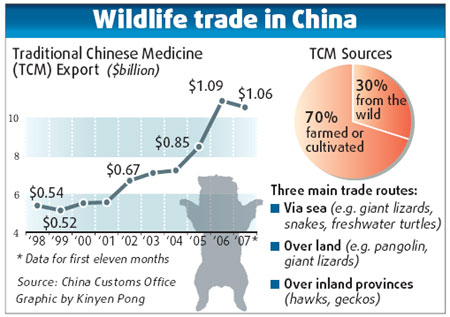 Wild animals are mostly smuggled in at the southwestern border and coastal regions, according to figures by Customs and major border points. Because the trade is illegal, the number of smuggling cases uncovered does not reflect the full extent of the animals and plants being brought into the country, Wan said. Last year, there were 87 criminal cases of endangered species being smuggled, up from 77 in 2005, said Wan. In 2007, there was a spike in cases to 175. "Illegal wildlife trade is alive and dynamic," said Xu Hongfa, director of the World Wildlife Fund's (WWF) TRAFFIC East Asia China Program. "We have noticed an increasing amount of trade and consumption in wildlife, including bear paws, tortoises, pangolins and monitor lizards," he said. The smuggling has severely impacted the wildlife populations in neighboring countries, particularly Southeast Asian nations, Wan said.
He said the demand stems partly from a "resource dilemma" faced by the country - rich in variety, but scarce in amount. "The demand comes from a traditional culture of using wildlife for food and medicine," he said. "It is not easy to change the cultural habits of 1.3 billion people." Chinese people have long believed in the medicinal and health benefits of wild plants and animals. The trade in TCM products has also been growing at an annual rate of 10 percent, which has seriously impacted medicinal plant and animal populations, though more than half of plants and animals being used by TCM are from artificial propagation or captive breeding. Up to 20 percent of these are now considered threatened. Eating wild animals is also a traditional practice in southern China. The consumption of wild animals, which slowed amid the SARS epidemic in 2003, has once again gained popularity, a WWF survey has found.
Illegal trade in tiger meat and bones is also alive, continuing to threaten the extinction of an already depleted species, he said. Alarmingly, Xu said, more wealthy people are demanding elephant ivory for decorative purposes. Of the 87 wildlife cases uncovered by the Customs last year, more than half involved ivory, Wan said. "The profit margin is as high as in drug trafficking but the punishment is too mild," he said. He Yong from the International Fund for Animal Welfare China said the demand for wildlife springs from weak links in law enforcement - the use and trade of wild animal products is banned, but artificial breeding is allowed in many instances to fulfill the needs of customers. |
主站蜘蛛池模板: 海安县| 田阳县| 客服| 高台县| 二手房| 合江县| 昭通市| 昭平县| 四平市| 恩平市| 当雄县| 香港 | 卢龙县| 蒙山县| 历史| 镇安县| 许昌县| 抚州市| 潞城市| 南康市| 阜新市| 黎城县| 株洲市| 霍城县| 日照市| 五指山市| 忻州市| 曲阳县| 内丘县| 茶陵县| 南安市| 樟树市| 尚义县| 衢州市| 彩票| 巴中市| 信丰县| 迁西县| 静安区| 朝阳区| 衡东县| 香格里拉县| 大厂| 桐柏县| 淅川县| 北流市| 临沧市| 鹿泉市| 大丰市| 清苑县| 延长县| 禄丰县| 红安县| 荔波县| 增城市| 邯郸县| 唐河县| 永吉县| 龙门县| 通河县| 顺平县| 南江县| 易门县| 平陆县| 彰化市| 景德镇市| 邛崃市| 西丰县| 文安县| 台南市| 榕江县| 芦山县| 开封县| 昌江| 崇阳县| 昌平区| 德钦县| 江口县| 梨树县| 浮梁县| 牙克石市| 盐亭县|



