CHINA> National

|
CHINA> National
|
|
China banking on IMF's bond idea
By Fu Jing (China Daily)
Updated: 2009-09-04 07:55 China will be expecting more input during the restructuring of the international financial system after agreeing on Wednesday to buy the first $50 billion of the International Monetary Fund (IMF)'s new bonds. The purchase, made three weeks before the Group of 20 Summit that will be held in Pittsburgh, is being seen as an example to the rest of the world of China's commitment.
Chinese think-tank economists said the purchase symbolized the country's "very first step" toward increasing its say in reshaping global financial institutions amid the financial crisis. The bonds also allow China to diversify its massive holdings of foreign reserves, giving it an alternative to purchasing US State bonds. And it will give the IMF the resources it needs to help other countries battle through the global crisis. IMF Managing Director Dominique Strauss-Kahn and Deputy Governor of the People's Bank of China Yi Gang signed the agreement at the IMF headquarters in Washington. Under the deal, the Chinese central bank "would purchase up to SDR 32 billion (around US$50 billion) in IMF notes". SDR (Special Drawing Right) is the name given to an interest-bearing IMF asset based on a basket of international currencies - the dollar, yen, euro and pound. The rate is calculated daily. IMF members can convert SDRs into other currencies.
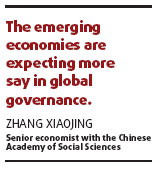
The IMF executive board approved the plan to issue the notes to governments and central banks in July. Russia and Brazil have both said they intend to buy $10 billion IMF bonds but, so far, their governments have not entered into an agreement. Zhang Xiaojing, senior economist with the Chinese Academy of Social Sciences, said he expects more voting rights will be allocated to China during the next round of IMF reform following the country's commitment to the institution. Developed economies currently dominate the international institution. The voting rights of the so-called BRIC countries - Brazil, Russia, India and China - amounts to 9.62 percent of the IMF total, despite the fact that they are some of the world's largest economies and most populous countries. The US, meanwhile, holds nearly 17 percent of the IMF's voting rights. "The emerging economies are expecting more say in global governance, which will represent their growing economic influence," said Zhang. "The developed bloc nodded their heads but said, you (the emerging economies) should contribute something first." Now that the world's economy has pulled out of its free-fall, Zhang said the IMF is in dire need of resources to help it support member nations as they battle to rebound from the global financial and economic crises. AFP reported that any bid by China to expand its formal influence at the IMF is likely to encounter resistance, especially from Europe, which has traditionally provided the fund's managing director. China's deal with IMF came within hours of an agreement by European Union finance ministers to raise the 27-nation bloc's contribution to the IMF to 125 billion euros ($178 billion), from 75 billion euros. Yu Yongding, a renowned economist from the same academy as Zhang, said China could have contributed more to increase the institution's resources to tackle the financial crisis. "However, to obtain the support of the public in China, I shall emphasize more fundamental reforms of the IMF, such as to increase China's voting rights are indispensable," Yu said. Li Jianwei, senior researcher on macroeconomics with the Development Research Center of the State Council, a powerful think-tank for the central government, said China's purchase was largely aimed at finding new ways to invest its $2.1 trillion in foreign reserves. "The bond purchase is diversifying China's investment opportunities for colossal foreign reserves," said Li. "The risk of the US dollar depreciating is high and we should think about the danger ahead." The IMF said the agreement offers China a safe investment instrument while boosting the fund's potential to help its members - particularly developing and emerging countries. But Zhang Xiaojing added: "We need to assess the safety of the investment because the world's recovery is still sluggish and financial systems remain fragile in many developed countries." |
主站蜘蛛池模板: 余干县| 民县| 富平县| 桑日县| 宜君县| 仁布县| 苍南县| 虎林市| 新平| 肃宁县| 新源县| 阜南县| 苗栗县| 赤峰市| 鹰潭市| 泰和县| 临沭县| 绥滨县| 灵武市| 大姚县| 商水县| 车致| 东兴市| 桐庐县| 浮山县| 临澧县| 弋阳县| 资阳市| 靖州| 福州市| 遂溪县| 凤山市| 新河县| 南陵县| 海原县| 福贡县| 白河县| 吴忠市| 九龙县| 平阴县| 句容市| 遂平县| 虎林市| 张家界市| 临海市| 肇庆市| 剑阁县| 长海县| 格尔木市| 土默特左旗| 中宁县| 扶风县| 伊春市| 包头市| 黎平县| 聂荣县| 新乐市| 堆龙德庆县| 沈丘县| 阿拉善左旗| 错那县| 永善县| 贵港市| 安义县| 嘉定区| 宜春市| 遂昌县| 青冈县| 桂阳县| 南京市| 舟曲县| 舞钢市| 大冶市| 新宾| 新泰市| 松江区| 南川市| 同江市| 泰和县| 眉山市| 德庆县| 罗田县|