CHINA> National


|
CHINA> National
|
|
China, Japan vow to promote bilateral ties
(Xinhua)
Updated: 2009-09-22 19:53
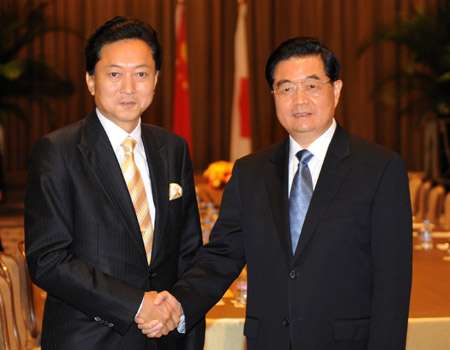
NEW YORK - Chinese President Hu Jintao and Japanese Prime Minister Yukio Hatoyama agreed to advance their bilateral ties during a meeting Monday on the sidelines of the U.N. General Assembly.
Hatoyama, who agreed with Hu's proposal to advance bilateral ties, said Japan would concentrate on promoting the relationship, which is based on common strategic interests. Monday's meeting was the first between the two leaders since Hatoyama was elected prime minister on September 16. Hu congratulated Hatoyama on his election victory, speaking highly of the active role the Japanese leader has played in improving and expanding China-Japan relations. China and Japan, Hu said, are friendly neighbors separated only by a narrow strip of water. He pointed out that both nations are important countries in Asia and the world. Hu noted that China-Japan relations are among each country's most important bilateral ties. He said cooperation and bilateral exchanges between China and Japan have reached unprecedented levels in a variety of fields since the two countries normalized relations 37 years ago. Leaders of the two countries, Hu said, have maintained close exchanges of visits and contacts, especially since 2006, as they decided to build a mutually beneficial relationship based on common strategic interests. "This was the first time that the two sides made positioning and planning of bilateral relations on a strategic level," Hu said. "During the state visit that I paid to Japan last year, the two sides planned the blueprint for future development of China-Japan relations and pointed out the direction of the growth of bilateral relations in the 21st century by issuing the fourth political document between the two countries," Hu said. The improvement and development of bilateral relations has not only brought major benefits to China and Japan, it also has contributed positively to peace, stability and prosperity in Asia and the world, Hu said. China has always viewed and developed China-Japan relations from a strategic and long-term perspective. Hu said China will continue to pursue its policy of China-Japan friendship and work with Japan to realize the goal of peaceful coexistence, friendship for all generations, mutually beneficial cooperation and common development. Hu, noting that the world is currently undergoing complicated and profound changes, said China and Japan are sharing additional common interests and challenges. "Bilateral relations are facing major opportunities for development at higher levels and in greater space," Hu said. He said China is ready to work with Japan to advance their mutually beneficial relationship based on common strategic interests in a sustained and extensive way. President Hu put forward five propositions on developing China-Japan relations. First, Hu said, the two countries should enhance high-level communications so as to improve political trust. Leaders of the two countries should maintain contact and continuously add political impetus to the development of bilateral ties. Second, Hu said, the two countries should promote trade and economic cooperation. China and Japan both are major world economies and important trade partners. Strengthening trade and economic cooperation will be conducive for both countries to overcome the international financial crisis and to encourage recovery for both economies at the earliest possible date, he said. Hu said the second high-level economic dialogue between China and Japan held in Japan in June set goals of trade and economic cooperation for the future. Relevant government departments of the two countries, Hu said, should take practical measures to fully implement the results of the dialogue so as to advance bilateral trade and economic cooperation to a higher level. Thirdly, Hu said, the two countries should improve the feelings of their people toward each other to consolidate the basis of good public opinion. Hu said the two sides should focus on the good trend of China-Japan friendship by carrying out exchanges between their young people, scholars and media. Fourthly, Hu said, the two countries should enhance cooperation on Asian affairs. As two important countries in the region, Hu said, China and Japan should jointly work for denuclearization on the Korean Peninsula and safeguard peace and stability in Northeast Asia. The two sides should also carry out dialogue, coordination and cooperation on global challenges such as the international financial crisis, climate change, environment and energy, he said. Fifthly, Hu said, China and Japan should properly deal with their differences and protect their friendship. As neighbors with close contact, China and Japan inevitably have some problems and differences in bilateral relations. The two countries should properly deal with these problems and prevent them from affecting their general bilateral relations. Hu said that the issues of history and Taiwan are two political concerns in China-Japan relations. Properly handling the two issues makes the basic and key precondition for healthy and steady development of bilateral ties. China hopes Japan could live up to its commitment and properly handle the two major issues with the general bilateral relations in its mind, Hu said. Hatoyama congratulated China for the 60th anniversary of the founding of the People's Republic of China. He said China's development has made great contributions to world peace and the global economy. Hatoyama said the Japanese government and people want to develop friendly relations with China. He said Japan will work to strengthen high-level communications, enhance mutual understanding and trust, deepen trade and cooperation with China in all fields, and to foster national feelings between the two peoples. Hatoyama said the Japanese government will stick to the August 15, 1995 statement by former Prime Minister Tomiichi Murayama on the history issue, in which Murayama made an apology for Japanese crimes before and during the war and expressed deep remorse and stressed the need for Japan to "convey to younger generations the horror of war" so that it will never repeat the mistake. Hatoyama also pledged that his government will continue to abide by the Japan-China joint declaration on the Taiwan issue. The two leaders also exchanged views on climate change and the situation on the Korean Peninsula.
|