CHINA> Special Reports

|
CHINA> Special Reports
|
|
A fertile environment for hi-tech growth
By Fu Shouqing (China Daily)
Updated: 2009-09-10 08:51
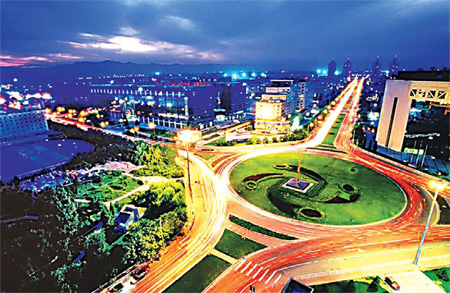
Crucial to the nation's first State-level hi-tech development zone, Zhongguancun Haidian Science Park (HSP) became known as "China's Silicon Valley" after it was founded 20 years ago, and is now home to more than 16,000 technology-based enterprises. HSP has had the most influence and success of Zhongguancun's 10 parks and one science zone, generating 394.1 billion yuan and about 50 percent of Zhongguancun's overall revenue. As its capacity for innovation and technological advancement continued to improve, HSP become the leading science park in China. It has also facilitated cooperation among universities, research institutes and industrial enterprises in Beijing and throughout the country over the past two decades. Yet the renowned park faces many challenges as its leading companies are not always competitive in the international market and rival science parks in China have proliferated. Today HSP plans to maintain its leading position by creating a more favorable environment for hi-tech businesses. The experience and lessons of hi-tech parks worldwide show the importance of a favorable environment for the sound development of enterprises. Business and nature both need a favorable environment - with competition and cooperation much like that in an ecological chain. An ecological chain Hi-tech enterprises in HSP form a kind of ecology that requires nurturing new growth, competition for resources and synergy to survive. On the top of the chain are the multinationals and famous domestic hi-tech companies. Multinationals such as Microsoft, Google, France Telecom, Ricoh, AMD, Novo Nordisk, Sony and Hitachi, have established regional headquarters, R&D centers and marketing centers in HSP, which now has the largest number of multinationals of any hi-tech park in China. A group of homegrown enterprises with international influence, such as Lenovo, have also developed in HSP. In 2004, Lenovo purchased the global PC service of IBM, becoming the third-largest PC manufacturer in the world, and in 2008, it joined the list of Fortune 500 companies. HSP is home to a dozen of independent industrial centers, such as Zhongguancun Software Park, Shangdi Information Industry Base and Zhongguancun Pilot Base for Creative Industries. Enterprises in the various centers have relationships based on supply and demand, with many small firms providing services to the large enterprises. Other important parts of the "ecological chain" in HSP are the relations among service providers, R&D entities and production enterprises. In recent years, HSP has increased its support to the information service, financial service and R&D industries. HSP has a large number of R&D institutes. There are over 500 research institutes, including 40 R&D centers established by 37 multinationals and 69 R&D facilities of Chinese enterprises. These facilities have offered strong support for the hi-tech development in the park as well as the entire city of Beijing. The government's role In the "ecological chain" of HSP, the local government also has an important role to play. Key elements influencing the environment for hi-tech industries are financial services, the park's level of internationalization, government services and university-industry-research cooperation. The administrative committee of HSP has a clear recognition of the four elements and has devised specific measures to create a sound environment for hi-tech industries to promote their mutually beneficial relations. Deepening university-industry-research cooperation is among such measures. Currently, the cooperation among industrial enterprises, universities and research institutes in Zhongguancun are far from close. The administrative committee expects to further promote such cooperation through conducting studies and research and establishing a database and information network for university-industry research cooperation. A demonstration base for university-industry-research cooperation is also expected to be set up in HSP, with preferential policies in place to encourage partnerships between universities and science parks and promote technology transfer. Promoting the development of enterprises by perfecting financial services is also an important task of the local authorities. The authorities' efforts including offering startup businesses financial assistant by establishing special funds, setting up special institutions to help enterprises get listed on stock markets, helping small and medium-sized enterprises grow through mergers, acquisitions and restructurings, and offering credit guarantees. In addition, the administrative committee is also endeavoring to attract international financial institutions to open operations in HSP. Over the past 20 years, one of the main reasons HSP has become stronger is that the local government has emphasized on provision of good services for businesses. In the years to come, the government will continue to improve services, through strengthening cooperation with various social organizations and improving transparency of administration and decision-making. Fu Shouqing is the deputy director of the Administrative Committee of Zhongguancun Haidian Science Park. |
主站蜘蛛池模板: 乐业县| 自贡市| 武隆县| 田阳县| 石城县| 通化县| 靖远县| 太谷县| 舟山市| 杭州市| 综艺| 英山县| 神池县| 临泉县| 阿合奇县| 师宗县| 山阳县| 彩票| 南投市| 乌拉特后旗| 汕头市| 华坪县| 鄱阳县| 青冈县| 民丰县| 白山市| 雷波县| 宁波市| 湖口县| 灵山县| 和政县| 宜黄县| 饶河县| 安远县| 石楼县| 如皋市| 九龙城区| 常德市| 南京市| 信阳市| 深泽县| 大化| 太谷县| 富宁县| 双城市| 大兴区| 大安市| 丹江口市| 云梦县| 安龙县| 长葛市| 宜州市| 三门峡市| 鹤岗市| 天水市| 长沙县| 怀远县| 白银市| 黔江区| 龙州县| 文安县| 彭山县| 凌源市| 巫山县| 乐昌市| 临夏市| 玉溪市| 镇宁| 沁源县| 格尔木市| 大足县| 永泰县| 小金县| 龙川县| 西宁市| 定陶县| 三门县| 临洮县| 宾阳县| 临澧县| 沙雅县| 星座|