Society
Modernity can be two-way street for cultural heritage
By Hu Yongqi (China Daily)
Updated: 2010-11-03 08:17
 |
Large Medium Small |
Learning the language
 |
|
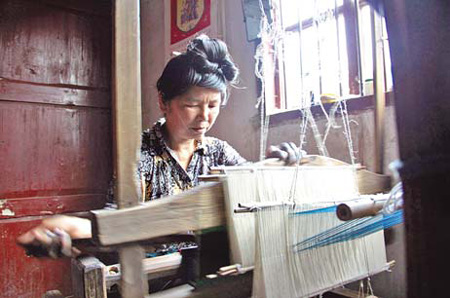
Pan Ying, 46, in Mandong village has been weaving for more than 25 years. The loom she uses is the same her mother used for about five decades. [Hu Yongqi / China Daily] |
And it is not only handicrafts that are at risk. Unique languages used only in remote regions of China could also disappear.
The dialects used in ethnic Miao and Dong villages have no written form and cultural heritage experts say they are racing against time to stop them dying out with older generations.
In the 1950s, almost every Miao could speak the ethnic language. Yet, today it is roughly only 45 percent, Lei Xiuwu, director of the Qiandongnan Institute of Ethnic Studies, said in his speech at the Ninth Senior Anthropology Forum in Kaili on June 22.
All 160 scholars in the audience agreed in a memorandum that a fundamental aspect of safeguarding ethnic cultures is to preserve their languages.
Museum director Cao Chunhan explained that, due to the popularization of compulsory education, children from ethnic groups no longer receive a bilingual education in Mandarin and their local dialects.
Youngsters living with migrant-worker parents in large cities also struggle to learn ethnic languages, usually because there is nowhere to study them.
To encourage a greater use of local dialects, Lei suggests authorities develop ethnic tourism.
 |
|
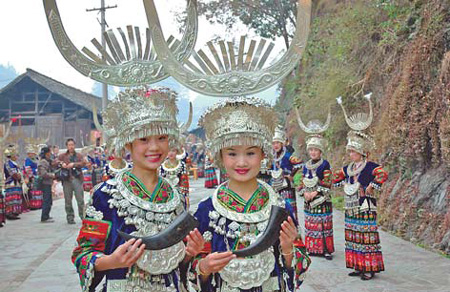
Young Miao women greet visitors at the entrance of their village with bull horns, which are traditionally used to hold rice wine. [Chen Peiliang / for China Daily] |
Xiao Qianhui agrees. As a visiting professor of tourism with Nankai University in Tianjin, he has been helping Qiandongnan to better cater to visitors for three years.
"The prefecture has a great advantage in its ethnic diversities and unique ecological environment," he told China Daily, "so tourism should be promoted to improve the living standard and preserve the traditional culture."
Qiandongnan is home to about 1.7 million ethnic Miao and 1.3 million ethnic Dong residents, making it an area rich in heritage.
A total of 39 traditions are already recognized as intangible cultural heritage at national level, with another 124 listed by Guizhou province. Experts say that all have the potential to attract tourists, such as the famous Dongzu dage, grand choirs of Dong singers.
"The traditions (already recognized) are only a few outstanding examples of our diverse cultures," said Su Zhourong, the prefecture's director of intangible cultural heritage. "We have to make use of these invaluable resources."
She said her office is now applying to the United Nations to recognize Miao traditional costumes as world cultural heritage.
Official tourism figures show that Qiandongnan received 14 million visitors in 2009, generating more than 10 billion yuan in revenue. The peak time was during the National Day holiday week in October, when residents earned in excess of 4.8 million yuan.
 主站蜘蛛池模板:
平邑县|
许昌市|
昭通市|
泽库县|
开化县|
柳州市|
安陆市|
岳阳市|
京山县|
长岭县|
古田县|
新和县|
平昌县|
蒙阴县|
个旧市|
积石山|
辽源市|
清水河县|
方城县|
沙河市|
临汾市|
玛多县|
深水埗区|
常德市|
务川|
阳江市|
景谷|
隆尧县|
龙南县|
镇雄县|
陵水|
保定市|
务川|
银川市|
桦甸市|
九龙城区|
龙门县|
沁源县|
开化县|
安国市|
杂多县|
漳平市|
房产|
漳州市|
开阳县|
金寨县|
罗田县|
会泽县|
宣化县|
上蔡县|
西城区|
阳原县|
桓仁|
嘉禾县|
峡江县|
上蔡县|
金华市|
龙泉市|
天水市|
满城县|
云安县|
涿鹿县|
普安县|
东明县|
马山县|
泸定县|
阿尔山市|
贵州省|
元氏县|
巢湖市|
林口县|
平武县|
康定县|
开江县|
栾川县|
柘荣县|
滁州市|
峨山|
全州县|
邮箱|
梁山县|
天水市|
主站蜘蛛池模板:
平邑县|
许昌市|
昭通市|
泽库县|
开化县|
柳州市|
安陆市|
岳阳市|
京山县|
长岭县|
古田县|
新和县|
平昌县|
蒙阴县|
个旧市|
积石山|
辽源市|
清水河县|
方城县|
沙河市|
临汾市|
玛多县|
深水埗区|
常德市|
务川|
阳江市|
景谷|
隆尧县|
龙南县|
镇雄县|
陵水|
保定市|
务川|
银川市|
桦甸市|
九龙城区|
龙门县|
沁源县|
开化县|
安国市|
杂多县|
漳平市|
房产|
漳州市|
开阳县|
金寨县|
罗田县|
会泽县|
宣化县|
上蔡县|
西城区|
阳原县|
桓仁|
嘉禾县|
峡江县|
上蔡县|
金华市|
龙泉市|
天水市|
满城县|
云安县|
涿鹿县|
普安县|
东明县|
马山县|
泸定县|
阿尔山市|
贵州省|
元氏县|
巢湖市|
林口县|
平武县|
康定县|
开江县|
栾川县|
柘荣县|
滁州市|
峨山|
全州县|
邮箱|
梁山县|
天水市|