Foreign and Military Affairs
Beijing seeks assurance on assets in US
By Li Xiaokun and Tan Yingzi (China Daily)
Updated: 2011-01-13 07:30
 |
Large Medium Small |
Hu's visit hailed as 'one of the most important' in history of bilateral ties
BEIJING /?WASHINGTON - Beijing on Wednesday asked Washington to assure the security of its financial assets in the country, as the United States is likely to further press China to revalue its currency during President Hu Jintao's visit there next week.


The US government and politicians have pressed Beijing for years to allow the yuan to rise more rapidly to help US exports to China, a policy they claim would create more jobs.
The White House said President Barack Obama will press US complaints about what it terms China's currency controls that critics say keep the yuan undervalued and swell its multibillion-dollar trade surplus.
On Wednesday, US Treasury Secretary Timothy Geithner pressed China again on the currency issue, saying it is one of the major concerns for the US during Hu's visit.
He said the Chinese currency should rise "more rapidly" in response to market forces.
In addition to the currency issue, intellectual property rights, market access to China as well as indigenous innovation policies are among other concerns of the US, he said in a speech in Washington.
Geithner said he recognized China's objectives, including more access to US high-tech exports, more investment opportunities in the US and market economy status.
But China should make progress on US concerns first before the US will be able to do its part, he said.
"China's rise offers us the opportunity of dramatic growth in demand for things Americans create and produce," Geithner said.
"But it will also force us to raise our game."
China has countered that US economic policies and its lack of manufacturing competitiveness are responsible for the imbalances, and urged the US to get its own fiscal house in order before its mountain of debt destabilizes the global economy.
Some Chinese economists said the US should not point fingers on the yuan issue.
The so-called yuan undervaluation is actually caused by the weakening of the US dollar, and China's export growth comes from its manufacturing competitiveness, not support from the currency, Chen Taotao, finance professor of Tsinghua University, told China Daily.
Dong Yuping, economist at the Chinese Academy of Social Sciences, noted that the yuan's revaluation in the past five years, by about 23 percent, has failed to help US exports.
"Yuan appreciation won't improve US exports. It would drive US orders to other countries, such as India and Malaysia, but the US trade balance won't improve," he said.
China has amassed the world's biggest stockpile of foreign exchange reserves at $2.85 trillion by the end of 2010, an estimated two-thirds of which are invested in US assets.
Premier Wen Jiabao said last March he was "worried" about holdings of assets denominated in the greenback. Many economists have criticized the US for using monetary policy to weaken the dollar and dilute its debt, which also reduces the value of Chinese holdings of dollar assets.
Underscoring China's sensitivity to the issue, an academic adviser to China's central bank, Xia Bin, told Reuters that global financial markets would be better off with a balance between the dollar and euro, as opposed to having only dollar dominance.
China remains the largest foreign holder of US Treasury securities, said Da Wei, a scholar on China-US relations with the China Institutes of Contemporary International Relations.
"What causes the most harm is the depreciating dollar, but it has been a fixed policy of the US government. And with the second round of quantitative easing working, I'm afraid emerging countries, including China, will face more inflationary pressure," he said.
Cui also told reporters that Hu will visit the US Midwestern business hub of Chicago, as well as Washington, during the Jan 18-21 trip.
Hu will meet Obama, senior officials and lawmakers, and will deliver a speech in Washington, Cui said, without giving details.
Common interests
He said China also expects to work with the US to push forward talks on the situation on the Korean Peninsula.
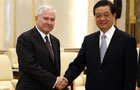
On Tuesday, visiting US Defense Secretary Robert Gates said in Beijing that Pyongyang could have inter-continental ballistic missiles within five years, and that the country posed a direct threat to the US.
China and the US "have broad common interests and share the same goal on the Korean nuclear issue," Cui said. "Both countries believe we must protect the peace and stability of the peninsula."
Chinese Ambassador to the US Zhang Yesui said on Wednesday, during an online chat on Hu's visit, that recent events on the Korean Peninsula proved that "exerting pressure and the use of force are not helpful to resolve the problem".
Instead, he called for an urgent meeting of chief negotiators of the Six-Party Talks.
US Ambassador to Beijing Jon Huntsman on Wednesday described Hu's visit, the first state visit by a Chinese president to the US in five years, as "one of the most important visits" in the history of Sino-US relations.
Zbigniew Brzezinski, former US president Jimmy Carter's national security adviser, said in an article published on Jan 2 in the New York Times that Hu's visit is the most important high-level visit since Deng Xiaoping went to the US in 1979.
Analyzing why Hu chose Chicago, Da Wei said the city, the third most populous in the US, has a vibrant economy.
Hu's last state visit to the US in 2006 took him to Washington DC, Seattle and Yale University.
Gao Changxin, Ma Liyao, Wang Chenyan, Xin Zhiming and Reuters contributed to this story.
?