Web Exclusive
Rent in peace at China's cemeteries
By Zuo Likun (chinadaily.com.cn)
Updated: 2011-04-02 07:11
 |
Large Medium Small |
|
 Sacrificial model villas are pictured at a market in Nanjing, capital of East China's Jiangsu province, on Tuesday, March 29, 2011, just a week ahead of Tomb-sweeping Day . [Photo/Asianewsphoto] |
Eco-Burial is the Future, But Old Habits Die Hard
Still, the urban cemeteries' lingering stigma of profiting from the dead is irrepressibly off-putting. What piques the public all the more is the fact that relatives of the deceased often have to ante up a large sum of money to buy a grave plot in the first place.
|
 |
The spending style, painfully aggressive sometimes, has a lot to do with China's conservative filial piety doctrine and entrenched feng shui dogma. In the eyes of the older generation, the funeral must be befittingly grandeur to prove a family's love for the deceased, lest one's virtue be in doubt. The tomb must have the right orientation and grand structure, or the family fortune would be threatened. An urn is of no use, since the human body must be kept intact in a coffin for ground burial.
Most people know that those outdated practices don't even remotely fit into the official policy. In a bid to save land and advocate the civic spirit, the Chinese government has banned the popular casket inhumation, requiring instead mandatory cremation and advocating modest funeral ceremonies.
However, old habits die hard. What's more, China's crammed cemeteries, with an alienating veneer of industrialized pipeline, have only stirred people's nostalgia for an idyllic age gone by.
|
 A sprawling graveyard is pictured in Qingdao city, East China's Shandong province on Wednesday, March 30, 2011. [Photo/Asianewsphoto] |
In a traditional China, warmer air heralded not only early spring, but also the age-old Tomb-sweeping Day, which, unlike its solemn name, is sort of a field day for family reunions and outdoor hikes. Folks visit temples to pray for their ancestors, bowing amid stinging incense fumes. On the light green hills, people burn joss paper at tomb sites. Firecrackers can be heard as wisps of their white smoke slowly fades into the air.
But in most Chinese cities, firecrackers and joss paper are banned for fear of forest fires. And the hustle and bustle of swarming visitors barely make the graveyard an appropriate place for quiet solace. On Tomb-sweeping Day, roads to and from major cemeteries are jammed with cars, forcing many to reschedule the annual family rite, or simply drop the plan.
|
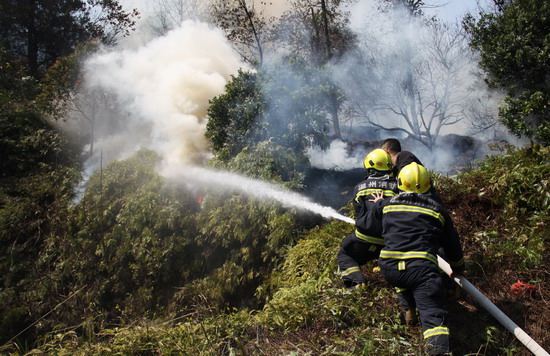 Firefighters douse a forest fire in Quxi county of Wenzhou city, East China's Zhejiang province, on Tuesday, March 29, 2011, just a week ahead of Tomb-sweeping Day. The municipal fire department has responded to multiple forest fires since the weekend. [Photo/Xinhua] |
The honest-to-goodness truth is, Chinese cities are crowded and cemeteries can't be the terminal for all. That's why the Chinese government has spared no effort in promoting a variety of environment-friendly burials.
After more than a decade of preferential policies, government-subsidized sea burials are gaining more social acceptance in many coastal provinces, such as Liaoning, Shandong, Jiangsu, Fujian and Guangzhou. While in inland regions such as Henan, Hubei and Hunan, innovative funeral services such as burials under trees are another option. Although there is no lack of resistance in some areas, the general trend is more social tolerance across the country.
More innovative forms of burial are put forward around the world. A Swedish company has developed an ecological way to handle a corpse: freeze-dry it, use sound waves to shatter the brittle body into powder, then the compost. You can even plant it in your garden. Susanne Wiigh-M?sak, founder of Promessa, said her company's method will leave a smaller carbon footprint as cremation burns a lot of fossil fuels.
Her business contracts have reached beyond Europe, into Africa and America. The company has signed agreements with South Korea to bring the practice to Asia for the first time. "The demand in the world is enormously big," she wrote in an email to China Daily.
Indeed, the funeral-related business is quite lively around the world. In Japan, the market had expanded to $18 billion as of late 2009. In America, death is a $15 billion a year industry.
Latecomer China is no exception. As of 2007, the country's 1,162 cemeteries had amassed 4.26 billion yuan ($591 million) in gross annual income, according to the most recent statistics published by a Civil Affairs Ministry's report on China' funeral development in 2010.